
A Waterfront Vision Is a Framework Before It Is a Destination
By Phillip Mullennax · · 5 min read
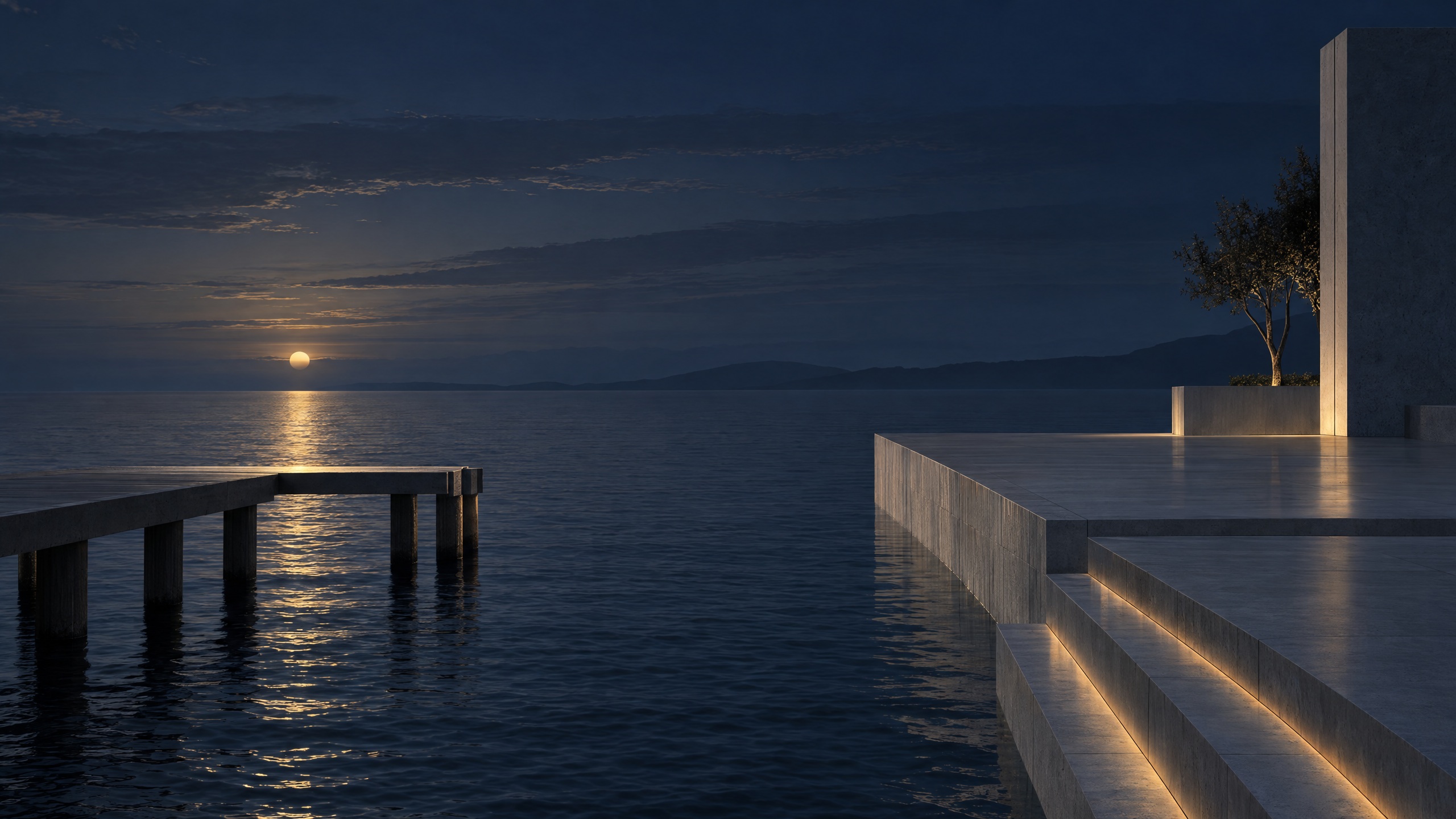
Public-safe editorial adaptation of the user-approved October 8, 2026 Fast Town Journal release. Original editorial illustration for Fast Town. Fictional and non-documentary. It does not depict Maldives Waterfront and Marina, a real marina, a developer rendering, a completed project, residence, or amenity. View the current source.
A commercial-terms agreement can set a direction. It cannot, on its own, prove a destination has been delivered or can be experienced.
A reader should treat the Maldives Waterfront and Marina announcement as the start of a commercial framework, not proof of a destination that can be experienced. On September 21, 2026, Eagle Hills and the Government of Maldives announced a commercial-terms agreement; WAM described an envisioned overall scale of about US$12 billion, while the Maldives Ministry described the project as US$20 billion. Those are conflicting headline figures, and they must remain attributed rather than blended. More importantly, the announced framework says detailed terms remain to be developed. That is the useful fact here: a waterfront vision becomes a real place only through the work that follows its first agreement. [1][2][3]
This is a reading framework, not a judgment on the proposal’s merits or a claim about delivery, availability, rights, or outcomes.
The difference between terms and a destination
The language of the announcement is unusually clear on sequence. Eagle Hills says the commercial-terms agreement sets out a shared vision and principal commercial terms, with detailed terms to be developed as the project progresses. WAM reports the same formulation. [1][3]
That is not a minor qualification buried beneath a larger announcement. It describes the present status of what was announced. A commercial-terms agreement can align parties around a broad direction. It can establish a basis for further work. It does not, by itself, establish the full conditions of a place in daily use.
The scale discrepancy reinforces the point. WAM puts the overall development scale “in the region of” US$12 billion across phases; Reuters separately reported that Eagle Hills announced an around-US$12 billion mixed-use project; the Maldives Ministry calls the development a US$20 billion project. Both figures appear in sources dated September 21, 2026. Neither source resolves the difference in this material. The disciplined response is not to choose the more dramatic number. It is to report the conflict plainly, name its sources, and wait for a reconciled basis before treating either as settled. [2][3][4]
What integrated waterfront language can mean—and cannot prove
The public descriptions outline an intended mix: hospitality, residences, a marina, waterfront leisure, retail, dining, entertainment, wellness, education, healthcare, community facilities, and public spaces. The Ministry likewise describes a phased plan with marina facilities, hospitality, residences, retail, entertainment, leisure, education, and healthcare infrastructure. [1][2][3]
These are proposed programme elements. They are not operating amenities, and they should not be written as though a visitor or resident can use them now. A list of intended components can show the ambition of an integrated waterfront concept. It cannot tell a reader how those uses will ultimately be defined, connected, maintained, governed, or experienced. Nor can it establish which elements will appear in any particular phase.
Integrated is therefore a direction, not a completed condition. It signals an aspiration to coordinate different kinds of space and activity. The term does not remove the need for specific, later evidence. Readers should resist the common slide from a named component to a claimed experience. A proposed marina is not an operating marina; a reference to hospitality is not a stay; and a plan for services is not a service delivered.
Why phasing and operating commitments matter
The Ministry describes the development plan as phased, while WAM describes scale across various phases. Phasing is more than a scheduling word. It is the structure that determines which questions must be answered in what order—and which questions cannot yet be answered from a headline announcement. [2][3]
For a waterfront reader with a long view, the relevant test is practical. What has been agreed at this stage? Which detailed terms are still to be developed? What later decisions will define the public-facing and operational reality of the proposed place? The source set answers the first two at a high level: commercial terms were announced, and detailed terms remain ahead. It does not turn the proposed elements into present conditions. [1][3]
Operating commitments deserve the same precision. A destination is experienced through repeatable realities: how spaces are looked after, how activity is coordinated, how the edge between water and land is managed, and how responsibility is made visible. Those are not decorative details that can be inferred from a programme list.

The question a long-view waterfront reader should ask first
Before asking whether a proposed waterfront concept sounds appealing, ask: what stage of the sequence does this announcement actually document? Here, the answer is specific. It documents a September 21 commercial-terms agreement between Eagle Hills and the Maldives Government, framed by the parties as a shared vision and principal commercial terms with detailed terms still to be developed. [1][3]
That answer provides a more useful starting point than either enthusiasm or dismissal. It makes room for a vision without mistaking it for a delivered environment. It also keeps readers from treating numerical scale as certainty when the public sources present two different figures: approximately US$12 billion from WAM and Reuters, and US$20 billion from the Maldives Ministry. [2][3][4]
The mature way to follow a waterfront plan is to keep the categories clean. State what was announced. Attribute what was claimed. Identify what remains unspecified. Then return to the record as later agreements, decisions, and operational detail are made public. A destination earns confidence through that sequence, not through the force of its first description.
Key takeaway
The September 21 announcement documents a commercial-terms agreement, not a delivered destination. Detailed terms remain to be developed, and the public sources conflict on headline scale: WAM and Reuters cite approximately US$12 billion; the Maldives Ministry cites US$20 billion. [1][2][3][4]
Fast Town point of view
A waterfront deserves to be read in sequence. The responsible question is not whether a proposed vision is impressive on announcement day; it is what has actually been agreed, what remains to be specified, and what later evidence will show about the place people may eventually encounter. That is an editorial standard, not a claim about this proposal or any relationship to it.
Source note
This independent, source-led analysis uses only the four listed sources. It reports their agreement framing, their stated scale figures, and the fact that detailed terms remain to be developed. It does not evaluate or advise on law, ownership, property rights, lease, transfer, inheritance, availability, price, financing, investment, or outcomes. Fast Town has no stated relationship, role, endorsement, or involvement in the Maldives Waterfront and Marina proposal; none is implied.
References
- [1] Eagle Hills, “Eagle Hills Signs Commercial Terms Agreement with the Government of Maldives for New Global Destination ‘Maldives Waterfront and Marina’” (September 21, 2026).
- [2] Government of Maldives Ministry of Infrastructure, Housing and Urban Development, “Eagle Hills to Build $20 Billion Megaproject in Rasmale” (September 21, 2026).
- [3] Emirates News Agency (WAM), “Eagle Hills signs commercial terms agreement with Government of Maldives for US$12 billion global destination ‘Maldives Waterfront and Marina’” (September 21, 2026).
- [4] Reuters, “UAE developer Eagle Hills unveils $12 billion project in the Maldives” (September 21, 2026).

Contributor
Phillip Mullennax
Journal contributor
Phillip Mullennax is listed as the author of this Fast Town Journal adaptation. His Leadership profile identifies his role in connecting editorial, media, analytics, and audience strategy across Fast Town’s public communications.
Learn more
Explore Fast Town’s public story around automobile culture, considered hospitality, place-led design, and the long view.
Continue the conversation
Related Articles
3 related articles
Development · Technology and Design
Waterfront Access Starts at the Threshold
By Phillip Mullennax
A waterfront becomes part of daily life through the small transitions that make shore, dock, path, and water feel connected.
October 3, 2026 · 4 min read
Development · Technology and Design
A Waterfront Plan Has to Work Before It Can Impress
By Phillip Mullennax
A waterfront has to serve real daily life before it can become a lasting destination.
September 17, 2026 · 4 min read
Development · Investment / REIP
Economic Scale Is Not a Development Brief: Four Questions for a Waterfront Destination
By Phillip Mullennax
A source-led framework for asking what access, utilities, information, operations, and public realm must keep doing well when conditions change.
August 19, 2026 · 3 min read