
Hospitality in Motion: What The Out Lap Shows About Environment Before Logo
By Phillip Mullennax · · 5 min read
Fast Town Journal · Hospitality Design · Brand Partnerships
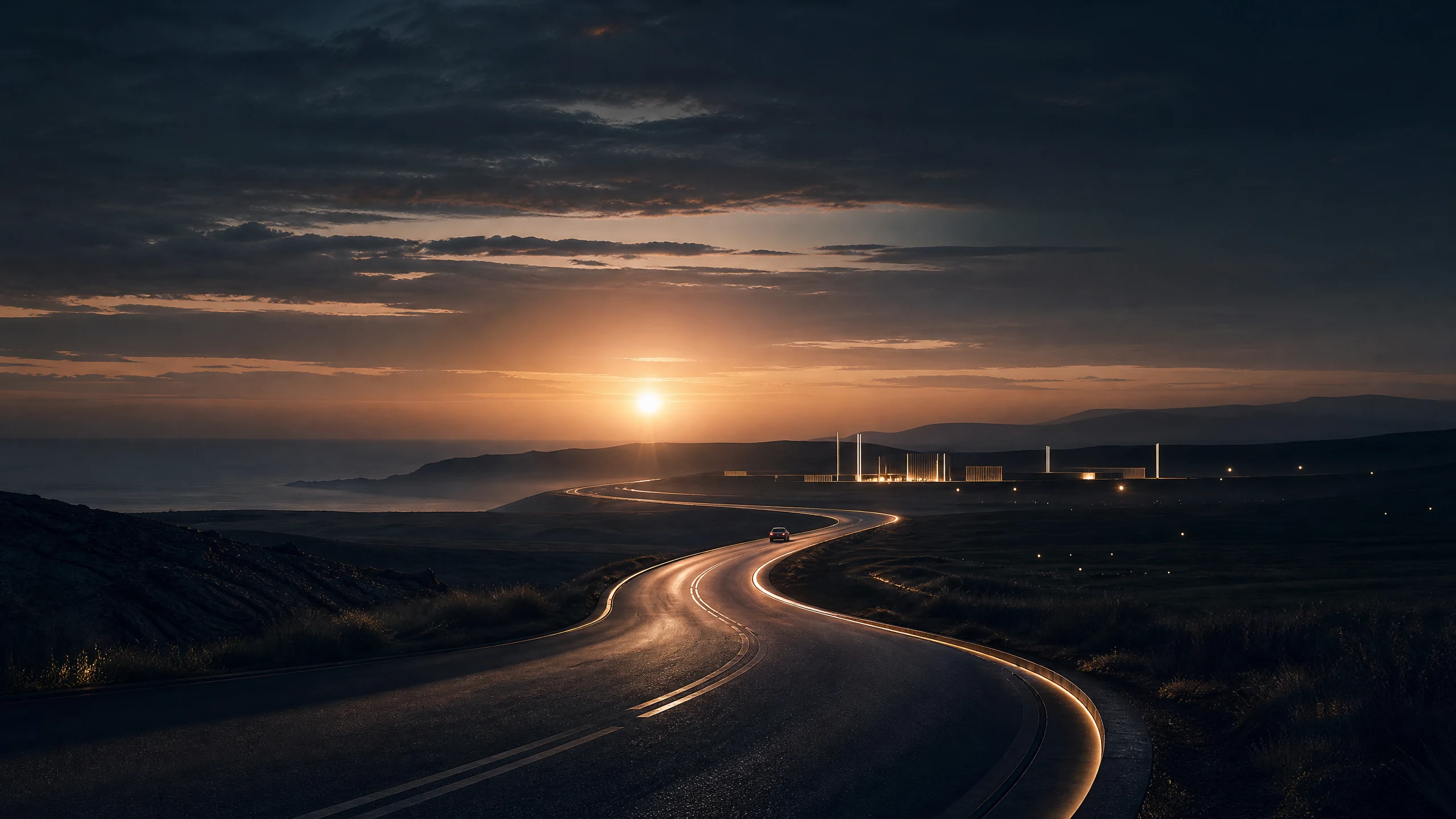
Public-safe editorial adaptation of the user-approved October 8, 2026 Fast Town Journal release. Original editorial illustration for Fast Town. Fictional and non-documentary. It does not depict The Out Lap, Moët Hennessy, LVMH, Formula 1, a circuit, product, meal, event, or guest experience. View the current source.
High-consideration hospitality earns attention when environment carries meaning, the journey gives it sequence, and disciplined hosts protect the guest’s experience.
How can hospitality design earn attention around a live sport without reducing guests to an advertising audience? Start with the experience itself: give people a reason to arrive, a sequence that makes sense in the setting, and hosts who can hold the room. Moët Hennessy and Formula 1 introduced The Out Lap as a hospitality concept. Moët Hennessy calls it the “world’s first moving fine-dining experience” on a Formula 1 circuit; that is campaign language, not an independent industry verdict. [1] The useful lesson is less the branded spectacle than the order of decisions: environment first, guest journey second, and host discipline throughout. What can travel is that discipline—not a format to copy.
This article is an independent reading of the cited public descriptions. It does not present the experience as a Fast Town offering, relationship, invitation, or outcome.
The guest journey is the product
The case begins with a clear physical proposition. Moët Hennessy’s July 17 release described a 12-guest travelling dining room moving through a circuit, with a route shaped around each Grand Prix and stops tied to the track’s history. Reuters reported the Spa experience during the Belgian Grand Prix weekend and described the vehicle as a glass-sided truck seating 12. [1][2]
That sequence has a job at every stage. Arrival establishes the premise. Movement changes the guest’s relationship to the venue. Stops create a reason to listen. The meal can then mark the transitions rather than compete with them. Moët Hennessy says each stop is accompanied by a former driver’s perspective and each chapter is interpreted through a culinary creation. Whether or not a guest knows the sport deeply, the structure gives the evening a legible spine: place, story, response, onward movement. [1]
The later editions show that the premise was designed to be locally interpreted rather than merely repeated. Formula 1 announced a Monza edition scheduled for September 4–5 with Massimo Bottura. Forbes later reported a Madrid edition pairing Quique Dacosta with Bruno Senna. Those are event-specific details, not a universal formula. The important editorial observation is that a shared framework can leave room for a place, a host, and a chef to do distinct work. [3][4]
Environment before logo
A circuit already contains built-in drama: distances, corners, sightlines, weather, waiting, and the knowledge that it normally serves a different purpose. The Out Lap’s source description is not of a dining room decorated with a racing theme; it is of a dining room moving through a circuit, with the route and stories tied to the venue. That distinction is the point. [1]
Environment-first design does not mean pretending a brand is absent. It means the brand is not asked to carry the whole experience by itself. The room, the timing, the point of view, and the sensory rhythm should communicate before a mark, bottle, or message has to explain anything. When the setting is doing real narrative work, brand presence can be quieter and more credible.
This is also where many hospitality concepts go wrong. A recognizable venue is treated as a backdrop, then covered with unrelated signals. The result can be polished but interchangeable. A better question is simpler: What can happen here that could not happen somewhere else? The answer might be a material, a view, a local craft practice, an operating ritual, or a piece of history. It has to change the guest’s experience, not just the event deck.
Why the host matters as much as the brand
A strong setting can still fail without someone responsible for attention. The Out Lap’s reported format puts a former driver’s perspective at the stops and places the chef’s interpretation alongside the track story. The roles are specific. One helps guests read the place; the other gives the experience a sensory response. Neither role needs to turn into a sales script. [1]
That is host discipline. The host sets tempo, understands when to explain and when to leave room for observation, and makes introductions feel useful rather than transactional. It is operational, not ornamental. A confident host can make a small group feel considered without treating them as a captive audience. A weak one can make an ambitious concept feel like a programmed tour.
The same applies to the handoffs. A good journey does not make guests wonder where to stand, when to move, or why the next moment matters. It makes each transition feel natural. In that sense, the host is part of the environment: not a spotlight, but the person who keeps the experience coherent.
What partnership teams can take from the case—without copying it
The wrong takeaway is to reproduce a moving dining room, a track, a chef, or a limited-seat format. Those are particular expressions within a particular context. Copying their surface would erase the thing that made them relevant in the first place.
The more useful takeaway is an operating sequence. First, identify the environment that has genuine meaning for the people in the room. Second, build a guest journey that reveals that meaning in stages. Third, give capable hosts clear responsibility for pace, context, and care. Only then decide what the brand needs to say—and what it can afford not to say.
There is no outcome claim embedded in that observation. The cited record does not establish a return on investment, audience result, or a general rule about commercial performance, and this article makes none. It is an independent reading of a specific hospitality case. Its value lies in the discipline of the design choices: use the place, respect the guest’s time, and put people in the room who can make both matter.
Key takeaway
High-consideration hospitality earns attention when the environment carries meaning, the journey gives that meaning a sequence, and disciplined hosts protect the guest’s experience. Brand presence should support that work, not substitute for it.
Fast Town point of view
Fast Town’s editorial point of view is that an experience should earn its brand presence. Start with a setting that matters, make the guest journey coherent, and assign real responsibility for hospitality. That is a standard for assessing experience design—not a claim of affiliation with, access to, or participation in The Out Lap or any named organization.
Source note
This is an independent, source-led editorial analysis. Campaign descriptions and “world’s first” language are attributed to Moët Hennessy; the Belgian Grand Prix reporting is attributed to Reuters; the Monza announcement is attributed to Formula 1; and Madrid details are attributed to Forbes. No source cited here establishes any Fast Town affiliation, access, invitation, partner relationship, booking, price, availability, guest result, return on investment, or future edition. This article is not an invitation, sponsorship communication, affiliate story, offer, or booking information.
References
- [1] Moët Hennessy, “Moët Hennessy and Formula 1 unveil The Out Lap: the world’s first moving fine dining experience on a Formula 1 circuit,” via PR Newswire (July 17, 2026).
- [2] Reuters, “Meals on wheels: Moet, F1 combine fine dining with lap of the track” (July 17, 2026).
- [3] Formula 1, “Formula 1 takes The Out Lap to Monza welcoming globally renowned chef Massimo Bottura” (August 25, 2026).
- [4] Y-Jean Mun-Delsalle, Forbes, “LVMH’s Wines And Spirits Division Crafts The Slowest Lap In Formula 1” (September 23, 2026; updated October 2, 2026).

Contributor
Phillip Mullennax
Journal contributor
Phillip Mullennax is listed as the author of this Fast Town Journal adaptation. His Leadership profile identifies his role in connecting editorial, media, analytics, and audience strategy across Fast Town’s public communications.
Learn more
Explore Fast Town’s public story around automobile culture, considered hospitality, place-led design, and the long view.
Continue the conversation
Related Articles
3 related articles
Culture and Performance
Motorsport Hospitality Is About More Than the Suite
By Phillip Mullennax
Motorsport hospitality works when it creates a real setting for shared attention, useful conversation, and relationships that do not feel manufactured.
August 25, 2026 · 4 min read
Lifestyle
What Lasts After the Event: The Community Standard Behind Great Automotive Gatherings
By Phillip Mullenax
A considered look at how invitation, setting, hospitality, and the subject itself can create a more lasting automotive gathering.
August 17, 2026 · 6 min read
Lifestyle
The Art of the Arrival: How Automotive Hospitality Is Becoming an All-Day Experience
By Phillip Mullennax
Why the most memorable automotive gatherings are shaped by the sequence around the car: road, display, conversation, and an intentional final impression.
August 13, 2026 · 5 min read