
Before the Hammer: Reading Lot 389’s Duesenberg Provenance Record
By Phillip Mullennax · · 5 min read
Fast Town Journal · Automotive Culture · Collector Cars · Provenance & Coachwork
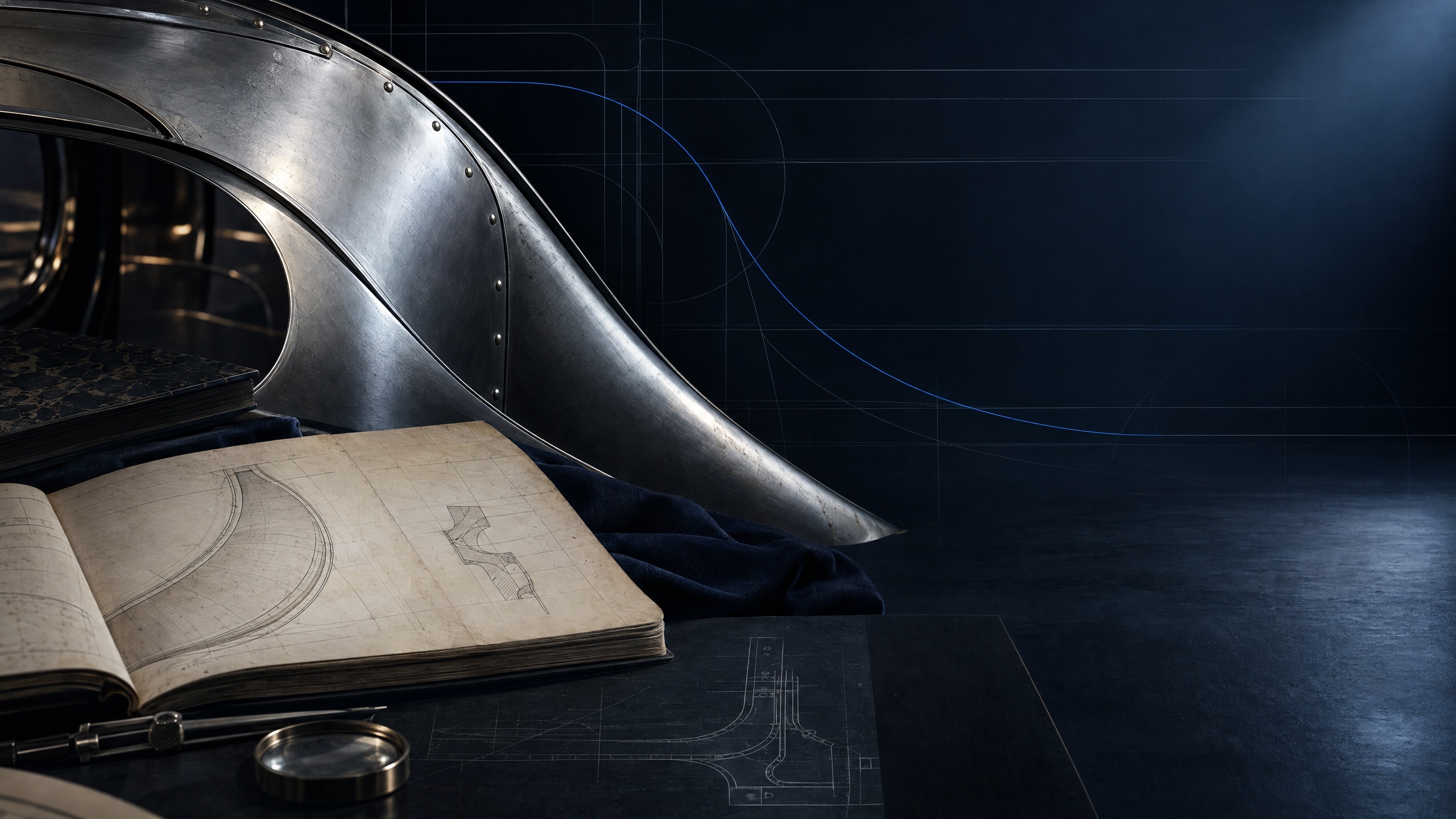
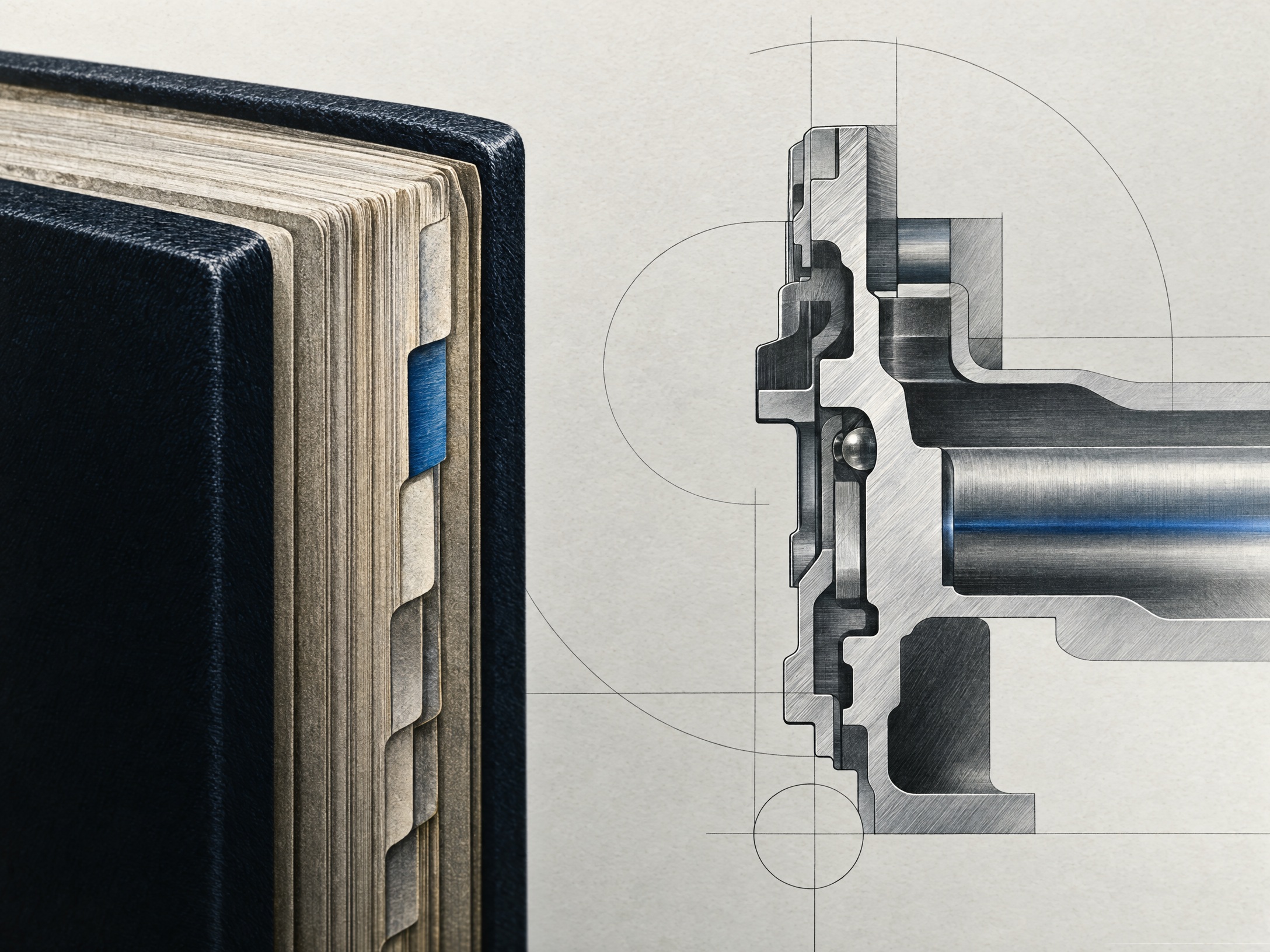
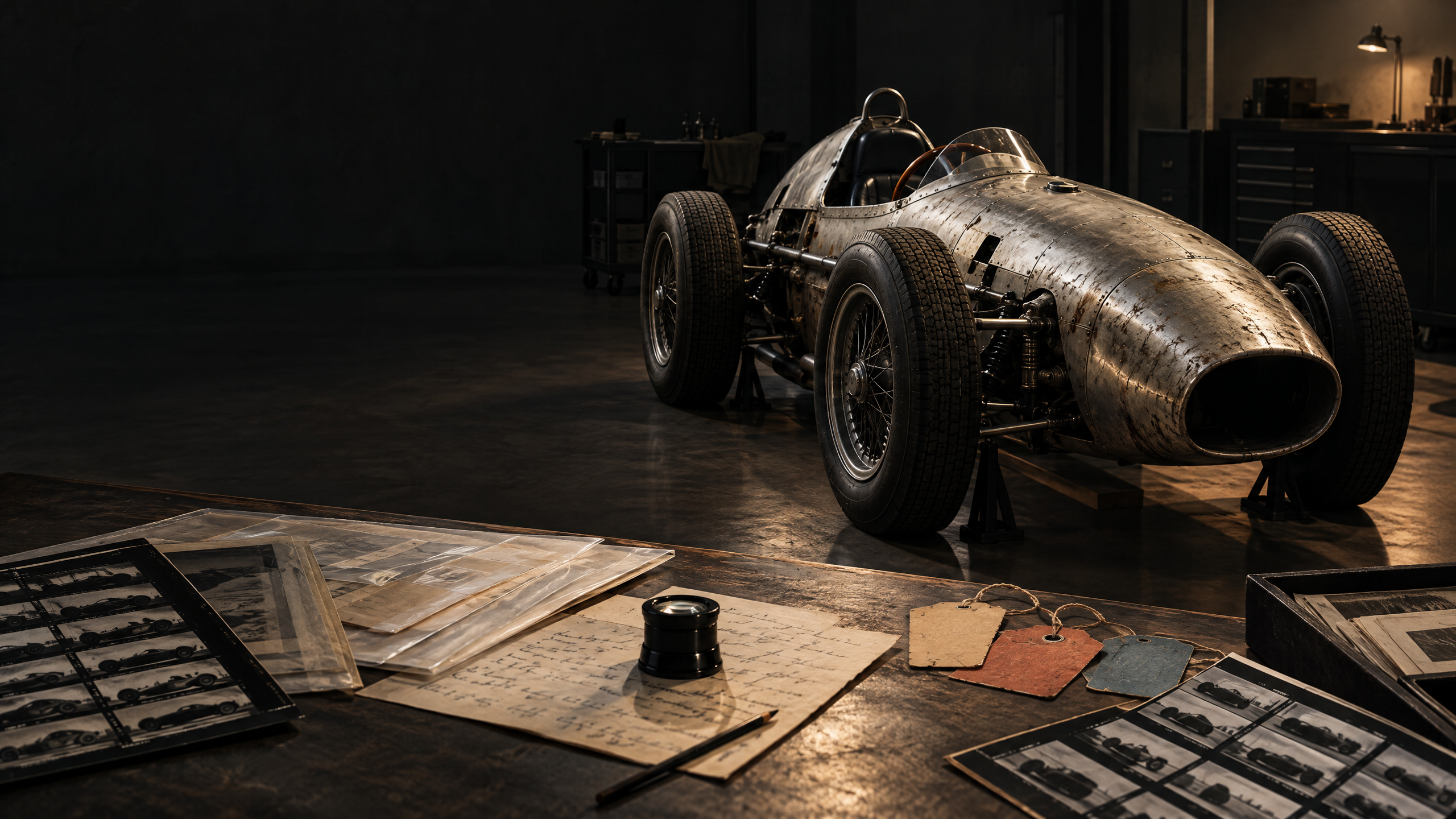
Public-safe editorial adaptation of the user-approved October 8, 2026 Fast Town Journal release. Original editorial illustration for Fast Town. Fictional and non-documentary. It does not depict a Duesenberg, Lot 389, RM Sotheby’s, AACA, Hershey, or any real vehicle or document. View the current source.
A collector reading a pre-war catalogue should read the body, the ownership narrative, and the disclosures as one record—not as separate headlines.
A collector reading a pre-war catalogue should start with the body, then read the ownership narrative and the disclosures as one record. RM Sotheby’s Lot 389—the 1934 Duesenberg Model J Convertible Berline by Murphy listed for October 8 in Hershey—is a useful current example. RM calls it one of about five surviving close-coupled Murphy convertible berlines and supplies a long custody story. The same catalogue explains that the present engine combines a J-416 bell-housing with the balance of engine J-405, and that the title uses a combination of chassis and engine numbers. It is not a footnote: a provenance story is only as useful as its elegant parts and its difficult parts read together. [1][2]
The lot page is time-sensitive. It should be read for its current addenda and status, not as a substitute for inspection or independent review.
What the catalogue actually says
RM lists The Hershey Auction for October 7–8, 2026 at the Hershey Lodge in Hershey, Pennsylvania; its event schedule lists a Thursday, October 8 auction at 5:00 p.m. EDT. Lot 389’s page says the car is to be offered on Thursday, October 8. The AACA brochure places the auction within the October 6–9 Eastern Fall Nationals program. [1][2][4]
The lot page identifies chassis 2434, engine J-416, firewall 2434, and a US title. RM’s pre-sale estimate is US$900,000–$1,200,000—a catalogue estimate, not an outcome or a verdict on the car. [1]
More useful than reciting the headline is seeing how RM builds the record. The catalogue attributes an early history to late Duesenberg historian Ray Wolff: chassis 2434 was sold as a chassis, received its Murphy body soon afterward, served as a Chicago factory-branch demonstrator, and was delivered on August 13, 1933 to William Boal Wood of Piqua, Ohio. It follows later custodians including Charles M. Knipe, Lorin Tryon, and Jack Finden, then says the present owner acquired the car in 2005. [1]
That is a substantial catalogue narrative, but still a catalogue narrative. A careful reader uses the named historian, dates, photographs, ownership sequence, and preparation notes to identify what supporting record to examine. That discipline keeps provenance from becoming recital.
Why the Murphy body is the draw
The coachwork deserves close attention because RM makes it central to the lot’s identity. The catalogue describes a rakishly angled windshield, rearward beltline molding, outward-curving flanks, and rounded rear top quarters. Those are visual markers for a reader standing in front of the car, not decorative copy. [1]
RM says only about five convertible berlines built to this close-coupled design remain. That survival wording belongs to RM; it should not become a broader claim about every Model J or Murphy-bodied car. RM’s release uses the same approximate-survivor framing. [1][3]
For a collector, body and provenance are connected. A precise body form gives the ownership trail an object to follow through period images, descriptions, fender treatment, color history, restoration work, and later appearances. RM says the car was photographed during Knipe’s ownership, those images were later published in an Auburn Cord Duesenberg Club newsletter, and the car was restored in its present two-tone blue scheme during later ownership. The catalogue also says it was mechanically recommissioned in preparation for sale. [1]
This does not make the car a simple preservation narrative. It explains why the Murphy form anchors the catalogue’s chronology.
Why the engine and title details belong in the story
The lot’s central lesson is in RM’s disclosure language. The catalogue says Knipe installed the present unit, combining the J-416 bell-housing with the balance of engine J-405 from his Murphy Convertible Coupe. That composite-engine configuration should remain plain in any discussion of the car. [1]
RM also places an addendum above the longer description: “this lot is titled using a combination of the chassis number and engine number.” With the composite-engine description, that tells a reader where shorthand becomes risky. Coachwork, presented numbers, engine configuration, and title wording are related parts of the file. [1]
The useful pre-sale questions are specific: What supports the title wording? How is the engine configuration described across the available record? Which history is directly documented, and which is catalogued from secondary research? What do body, mechanical systems, and restoration presentation show on inspection? The catalogue guides those questions; it cannot answer them alone.
Transparent wording matters more than a frictionless story. A disclosure does not erase coachwork or ownership history, and attractive coachwork should not bury a disclosure. Each affects how fully a collector understands the offering.
The collector’s work happens before the hammer
Hershey’s setting makes the method visible. RM calls its sale the official auction of the AACA National Fall Meet, while AACA identifies the October 6–9 Eastern Fall Nationals as the surrounding program. Cars, records, specialists, and informed conversation can sharpen questions; they do not remove the need to ask them. [2][4]
For Lot 389, start with the catalogue, not a sweeping label. Read the Murphy description beside the ownership chronology and the composite-engine passage beside the title addendum. Compare the car in person with the condition language; ask for clarity where the record needs it. RM’s lot page begins the inquiry; it does not end it. [1]
Do not ask a catalogue to be something it is not. Let it identify the car, frame questions, and disclose complications; then do the slower work that provenance requires.
Key takeaway
RM’s Lot 389 is most instructive not as a number or a trophy, but as a record to read whole: rare close-coupled Murphy coachwork, a catalogued ownership sequence, a disclosed composite engine, and a combined chassis/engine title statement. [1]
Fast Town point of view
The collector’s standard should be clarity over shorthand. A compelling object can carry an intricate history; that is not a problem to smooth away. The better field note names what the record says, marks what still requires review, and leaves room for direct inspection and informed judgment.
Source note
This independent, pre-sale editorial analysis is limited to the four cited RM Sotheby’s and AACA sources. Lot-specific history, coachwork survival language, mechanical configuration, title wording, schedule, and estimate are attributed to RM Sotheby’s where stated. It is not an appraisal, condition report, title opinion, bidding guidance, or purchase recommendation. Fast Town is not presented as affiliated with RM Sotheby’s, AACA, the Hershey event, the consignor, or the lot.
References
- [1] RM Sotheby’s, “Lot 389: 1934 Duesenberg Model J Convertible Berline by Murphy.”
- [2] RM Sotheby’s, “The Hershey Auction 2026” event page.
- [3] RM Sotheby’s, “RM Sotheby’s Marks 20 Years at Hershey, Led by Duesenberg Model J, Auburn 851 Speedster, and Brass Era Mercedes.”
- [4] Antique Automobile Club of America, 2026 Hershey brochure (PDF).

Contributor
Phillip Mullennax
Journal contributor
Phillip Mullennax is listed as the author of this Fast Town Journal adaptation. His Leadership profile identifies his role in connecting editorial, media, analytics, and audience strategy across Fast Town’s public communications.
Learn more
Explore Fast Town’s public story around automobile culture, considered hospitality, place-led design, and the long view.
Continue the conversation
Related Articles
3 related articles
Automotive Culture
What a Concours Can—and Cannot—Confirm
By Phillip Mullennax
A concours trophy can focus attention on a car. The record behind it—identity, condition, stewardship, and evidence—is what lets the story stand up over time.
October 1, 2026 · 4 min read
Automotive Culture
A Daughter’s Promise, A Cobra’s Return
By Phillip Mullennax
A long-dormant Cobra restoration becomes a story of family continuity, careful evidence, and the patient work of returning a car to the road.
September 22, 2026 · 4 min read
Automotive Culture
What a Competition Car Carries Forward
By Phillip Mullennax
The latest trophy is one line in a longer record. A 1928 Mercedes-Benz SSK shows why provenance, careful stewardship, and legible restoration give a competition car lasting meaning.
September 15, 2026 · 4 min read