
Waterfront Access Starts at the Threshold
By Phillip Mullennax · · 4 min read
Fast Town Journal · Development · Technology and Design
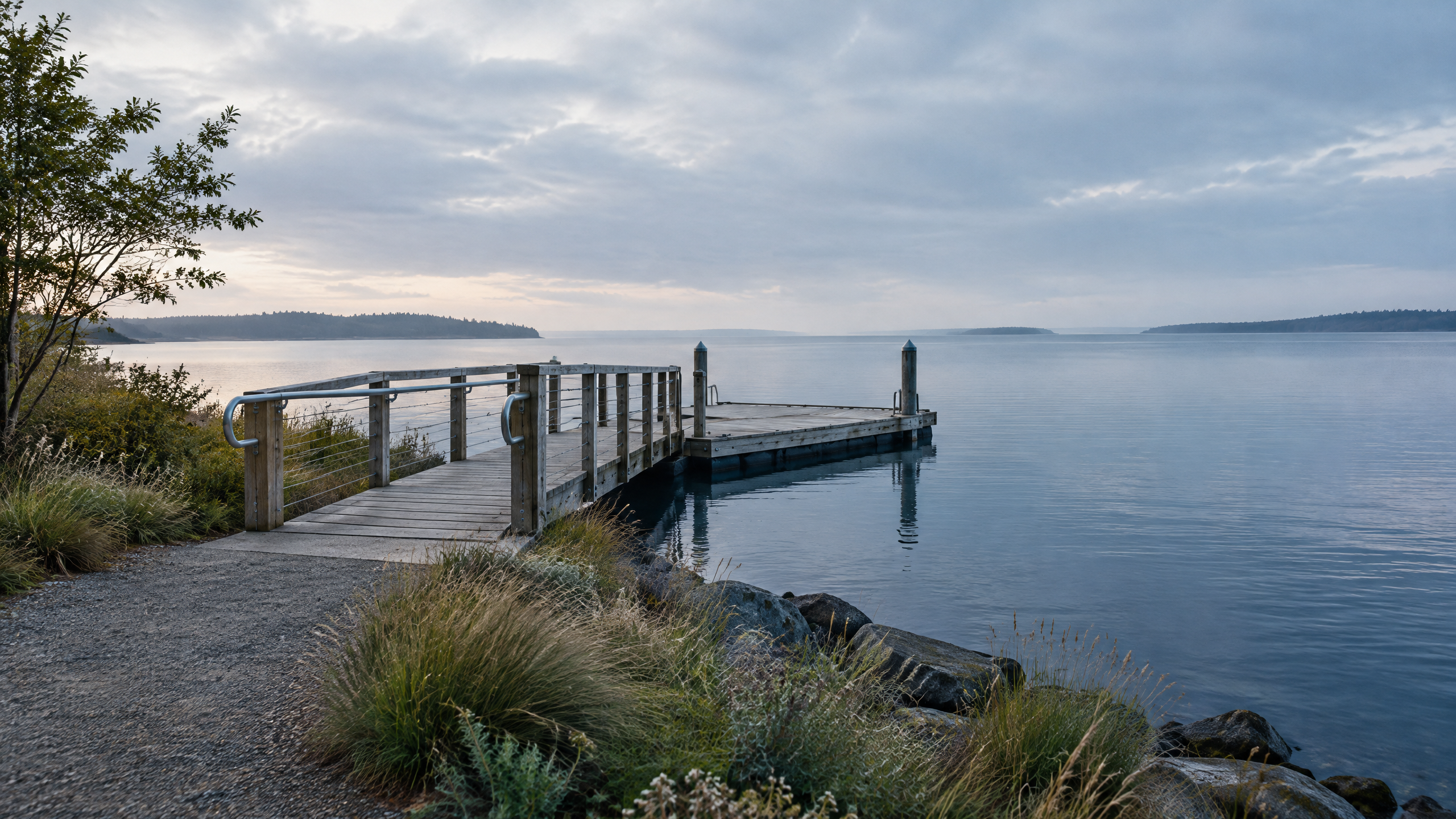
Public-safe editorial adaptation of the approved Fast Town Weekly ICP 2 release. Original editorial illustration for Fast Town. Fictional setting; not a depiction of Geneva, Seneca Lake, Long Pier, or the announced project. View the current source.
A waterfront becomes part of daily life through the small transitions that make shore, dock, path, and water feel connected.
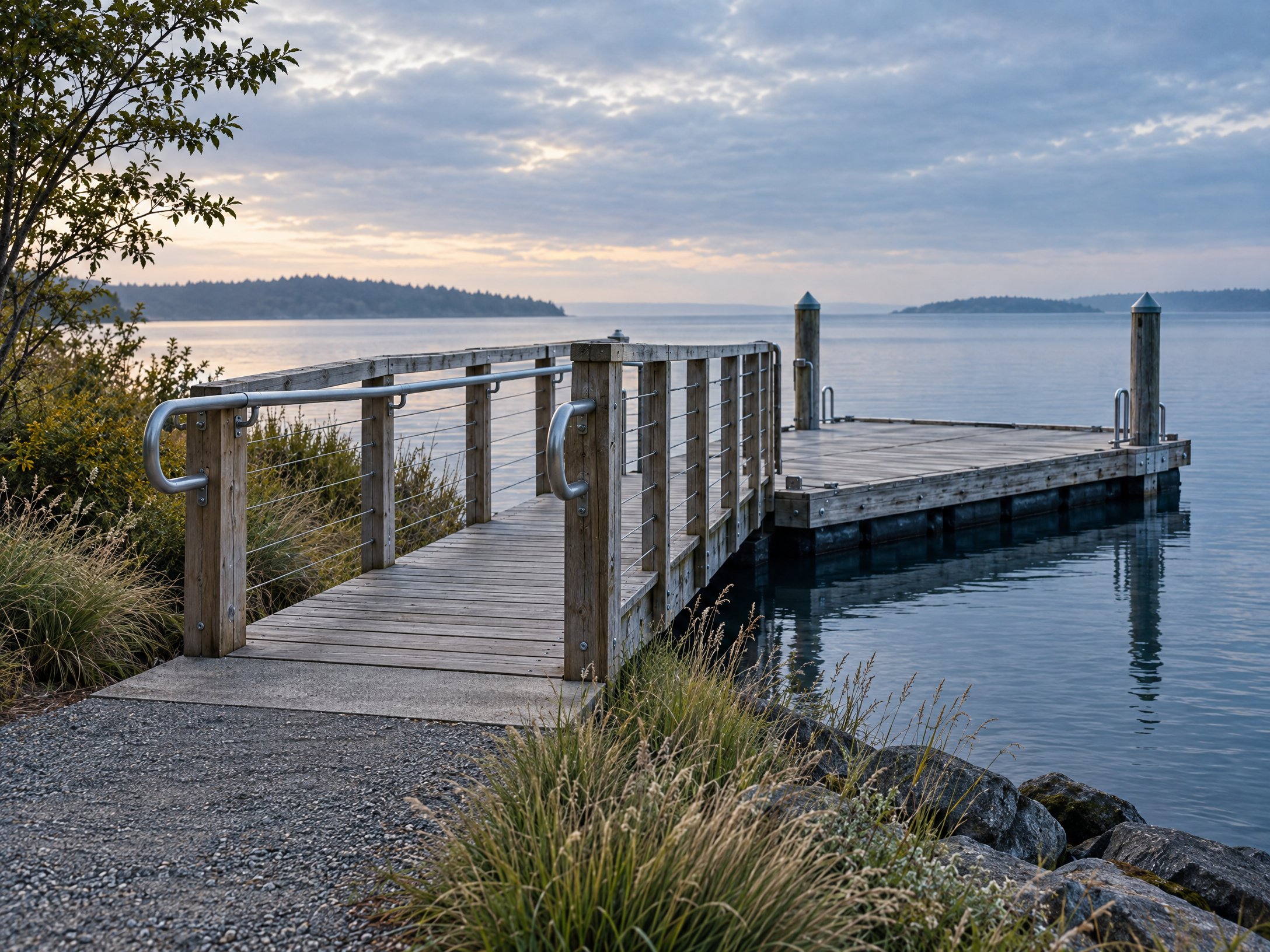
A waterfront can have a memorable horizon and still fail the moment someone tries to reach the water. The durable work happens closer to the ground: at the path, the handrail, the gangway, the pier edge, and the point where a person decides whether the water is actually part of the day.
That is why the City of Geneva’s new marina and Long Pier work on Seneca Lake is worth watching as a planning story. New York’s Department of State announced September 9 that the project had broken ground, with a new 3,440-square-foot floating dock system, an accessible floating kayak launch, a 35-by-4-foot gangway, fixed-bulkhead repairs, and stabilisation and repair work across approximately 12,400 square feet of Long Pier.[1] Local reporting separately confirmed that work had started.[2]
The project is still construction work. It is not a finished access experience, and the announced features are not proof of an operating outcome. But the decisions in the plan point to a useful principle: a waterfront begins at the threshold between shore and water.
The edge is where a waterfront becomes real
The difference between looking at water and using it is rarely one grand gesture. It is usually a series of small, practical transitions.
Can people find the route from the street or public path to the water? Does the change in level make sense? Does a dock feel connected to the shoreline instead of stranded beyond it? Is the pier doing the quiet work of safely carrying people through the sequence?
Geneva’s announced components are specific because the problem is specific. A floating dock, a gangway, a stable edge, and a launch designed with transfer and grip features are not decorative elements. They are the connective tissue between a waterfront vision and the experience of getting there.[1]
The point is not that every waterfront needs the same equipment. It is that access has to be considered as a continuous journey rather than a scenic afterthought.
A plan should say what is changing—and what is not
There is a useful discipline in describing a waterfront project while construction is underway. Planned work should be called planned work. A groundbreaking should not be written as an opening. An announced accessible feature should not be overstated as a certification, a guarantee of universal usability, or a promise about operating hours.
That precision makes the eventual result more credible, not less. New York’s announcement says the project will replace the existing floating-dock system, add the new kayak launch and gangway, and repair the fixed bulkhead and Long Pier.[1] It does not establish that the new infrastructure is complete or available today.
This is more than editorial housekeeping. Good public-realm thinking leaves room for the difference between intent, construction, operation, and stewardship. The four stages ask different things of a project, and they should not be blended together for the sake of an easy headline.
A dock is part of a larger system
The most successful waterfronts do not treat the dock as the destination. They make it one part of a legible sequence: town to path, path to shore, shore to water, water back to community.
Geneva’s project carries a particularly literal version of that idea. The Department of State said construction equipment would travel by barge from Cape Vincent through the St. Lawrence River, Lake Ontario, the Oswego Canal, Erie Canal, and Cayuga-Seneca Canal to Seneca Lake.[1] That route is a logistical detail, but it also reinforces the fact that waterfront systems are rarely isolated. They are connected to waterways, streets, maintenance, public expectations, and the routines that keep a place in use.
For a waterfront to stay useful over time, the visible edge needs the less-visible systems behind it: maintenance, movement, information, and a clear owner’s willingness to keep the basics working.
Design for the ordinary day
The best test of a waterfront is not its opening photo. It is an ordinary day.
Can someone arrive without having to decipher the place? Can a family, a paddler, a walker, or a visitor understand the next step without being pushed through a maze of visual gestures? Does the infrastructure invite a relationship with the water that can happen repeatedly rather than only on a special occasion?
These are small questions, but they are where a waterfront earns continuity. The view may draw people in. The threshold decides whether they stay connected.
At Fast Town, we think the durable value of place starts with the parts people actually encounter. A waterfront should feel considered before it asks to be admired: how people move, how the edge is maintained, how a path meets a dock, and how the experience works when nobody is staging it for a camera.
A lasting waterfront is not made by the horizon alone. It is made by the simple, repeated transitions that let people reach, use, and return to the water with confidence.
Source note
This article uses the New York Department of State’s September 9, 2026 announcement and local reporting from WHEC/News10NBC for the start of work and stated scope.[1][2] It does not state that the project is complete, open, operating, certified accessible, universally usable, environmentally effective, safe in all conditions, or available at any particular hours. It makes no claim about property values, project performance, marina capacity, tourism, public funding outcomes, or a Fast Town relationship with Geneva, New York State, or the project.
References

Contributor
Phillip Mullennax
Journal contributor
Phillip Mullennax is listed as the author of this Fast Town Journal adaptation. His Leadership profile identifies his role in connecting editorial, media, analytics, and audience strategy across Fast Town’s public communications.
Learn more
Explore Fast Town’s public story around automobile culture, considered hospitality, place-led design, and the long view.
Continue the conversation
Related Articles
3 related articles
Development · Technology and Design
A Waterfront Plan Has to Work Before It Can Impress
By Phillip Mullennax
A waterfront has to serve real daily life before it can become a lasting destination.
September 17, 2026 · 4 min read
Development · Investment / REIP
Economic Scale Is Not a Development Brief: Four Questions for a Waterfront Destination
By Phillip Mullennax
A source-led framework for asking what access, utilities, information, operations, and public realm must keep doing well when conditions change.
August 19, 2026 · 3 min read

Development
The Day After the Storm: A Waterfront Readiness Conversation Before the Doors Open
By Phillip Mullenax
A general educational framework for treating coastal readiness as an evidence threshold, not a visual impression or a map result.
August 17, 2026 · 6 min read