When the Code Drives the Car
By Phillip Mullennax · · 3 min read

Fast Town Journal · Motorsport Culture · Culture and Performance
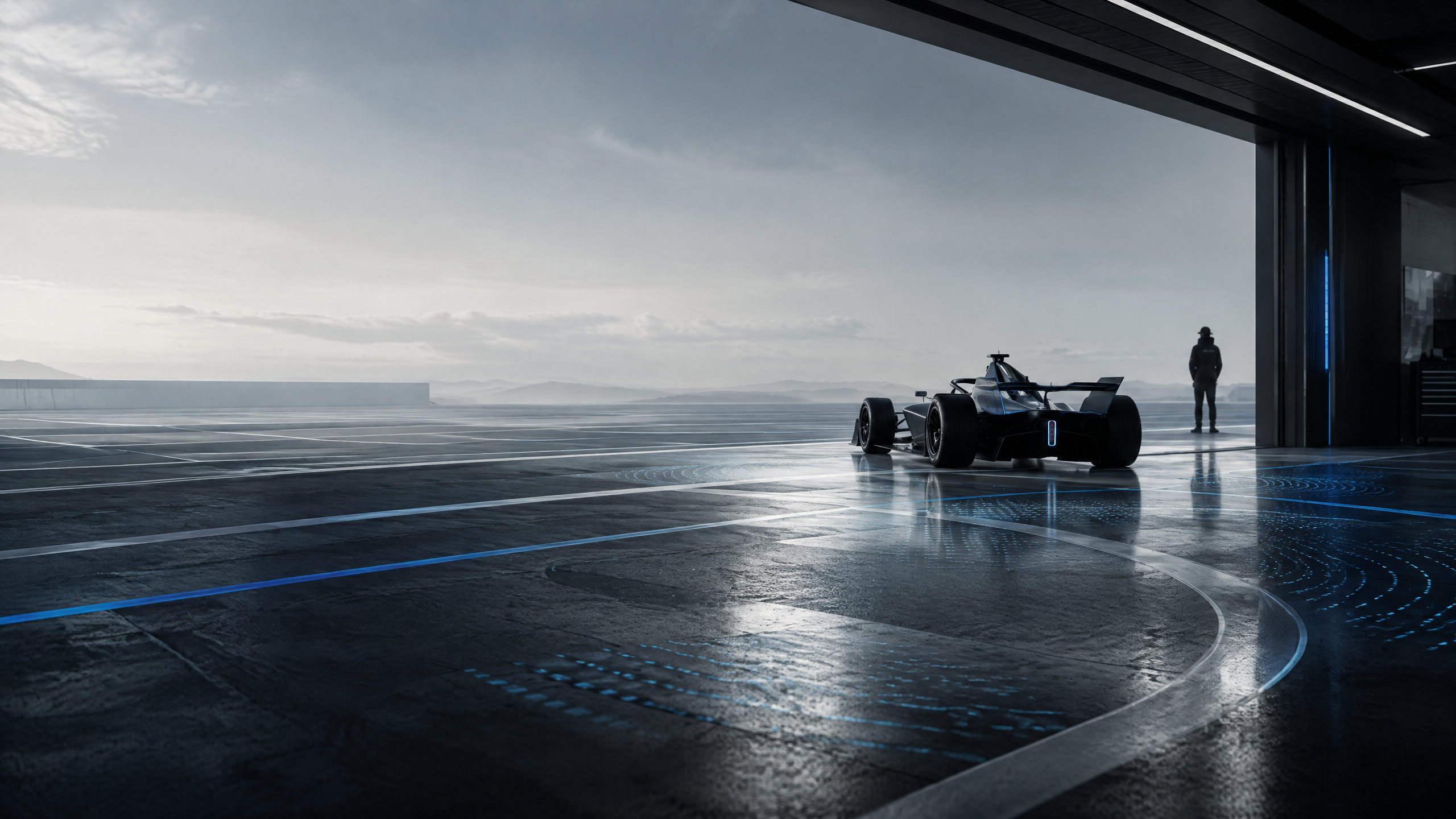
Public-safe editorial adaptation of the user-approved Fast Town Weekly ICP 3 prepared release candidate. The hero is an original conceptual editorial illustration of a fictional single-seater; it does not depict Formula 1, Oscar Piastri, Spa, Baku, a team, a vehicle, a circuit, or documentary events. View the current source.
When software becomes visible in the cockpit, the question is no longer whether code matters. It is how it changes the performance a driver can feel.
Oscar Piastri recently described a consequence of Formula 1’s 2026 energy-deployment systems that is hard to reduce to a setup note: “Sometimes” a driver can feel like a passenger of the system. [1]
At Spa, Piastri said the middle sector could be run on combustion power alone, without battery assistance. He also said that small differences in the code and engine behaviour could meaningfully affect lap time, even when the front of the field was separated by only nine hundredths of a second. [1]
That does not make the driver irrelevant. It does make the relationship between driver, car, and software more visible.
The system has become part of the lap
The new-generation cars use a near-even split between electrical and internal-combustion power, according to Motorsport Week’s report. The systems managing deployment learn the circuit and determine how battery power is used across a lap; the driver does not make deployment decisions directly. [1]
Piastri’s point is not that software is new to Formula 1. It is that the software’s influence is now easier for drivers and viewers to feel at circuits where energy recovery and deployment become a central constraint.
Why circuit shape matters
Piastri specifically contrasted Spa and Silverstone with shorter-straight venues such as the Hungaroring and Zandvoort. On the longer circuits, he said the consequences can be more pronounced. The issue is not a single corner or a single setting. It is how the deployment strategy unfolds over the full lap. [1]
The Azerbaijan Grand Prix ran September 24–26. Baku’s long shoreline straight and its narrow city sections make it a useful setting for a conversation about energy management, even though no single weekend can settle the wider question. [2]
What this changes in the experience
Software has shaped racing performance for decades. The difference now is one of visibility. The code is no longer only an engineering story behind the garage door. It is part of the performance a driver feels in the cockpit and a fan sees in the timing.
That raises a simple design question: when does a system help a human performance become clearer, and when does it become the performance itself? The answer will keep changing, but the question is now part of the sport.
When code becomes visible in the cockpit, it becomes part of the performance people can feel.
Source note
This article relies on the cited Motorsport Week report for Piastri’s remarks about 2026 energy deployment, Spa’s middle-sector battery use, the stated lap-time comparison, and the venue contrast, and on Formula 1’s official calendar for the September 24–26 Azerbaijan Grand Prix schedule. It does not predict race results, performance, safety, strategy, technology superiority, data security, driver control, investment, or commercial outcomes, and it does not claim any Fast Town relationship with Formula 1, Oscar Piastri, a team, a circuit, or the cited events. [1] [2]
References

Contributor
Phillip Mullennax
Journal contributor
Phillip Mullennax is listed as the author of this Fast Town Journal adaptation. His Leadership profile identifies his role in connecting editorial, media, analytics, and audience strategy across Fast Town’s public communications.
Learn more
Explore Fast Town’s public story around automobile culture, considered hospitality, place-led design, and the long view.
Continue the conversation
Related Articles
3 related articles
Motorsport Culture · Culture and Performance
When a Racing Technology Company Becomes a Team
By Phillip Mullennax
Moving from the pit lane to the grid changes the job. The work is no longer only the technology—it is the operating system that has to make it perform together.
October 4, 2026 · 4 min read
Motorsport Culture · Culture and Performance
The Test Track Is Becoming a Software Environment
By Phillip Mullennax
The test track is becoming more than a place to measure a machine. It is becoming a visible environment for software, systems, and people.
September 18, 2026 · 4 min read
Motorsport Culture · Culture and Performance
The Next Step into Customer Racing Should Be Legible
By Phillip Mullennax
A new Porsche customer-racing entry point prompts a bigger question: what makes a meaningful transition from track-day familiarity to structured competition?
September 2, 2026 · 5 min read