
The Next Step into Customer Racing Should Be Legible
By Phillip Mullennax · · 5 min read
Fast Town Journal · Motorsport Culture · Culture and Performance
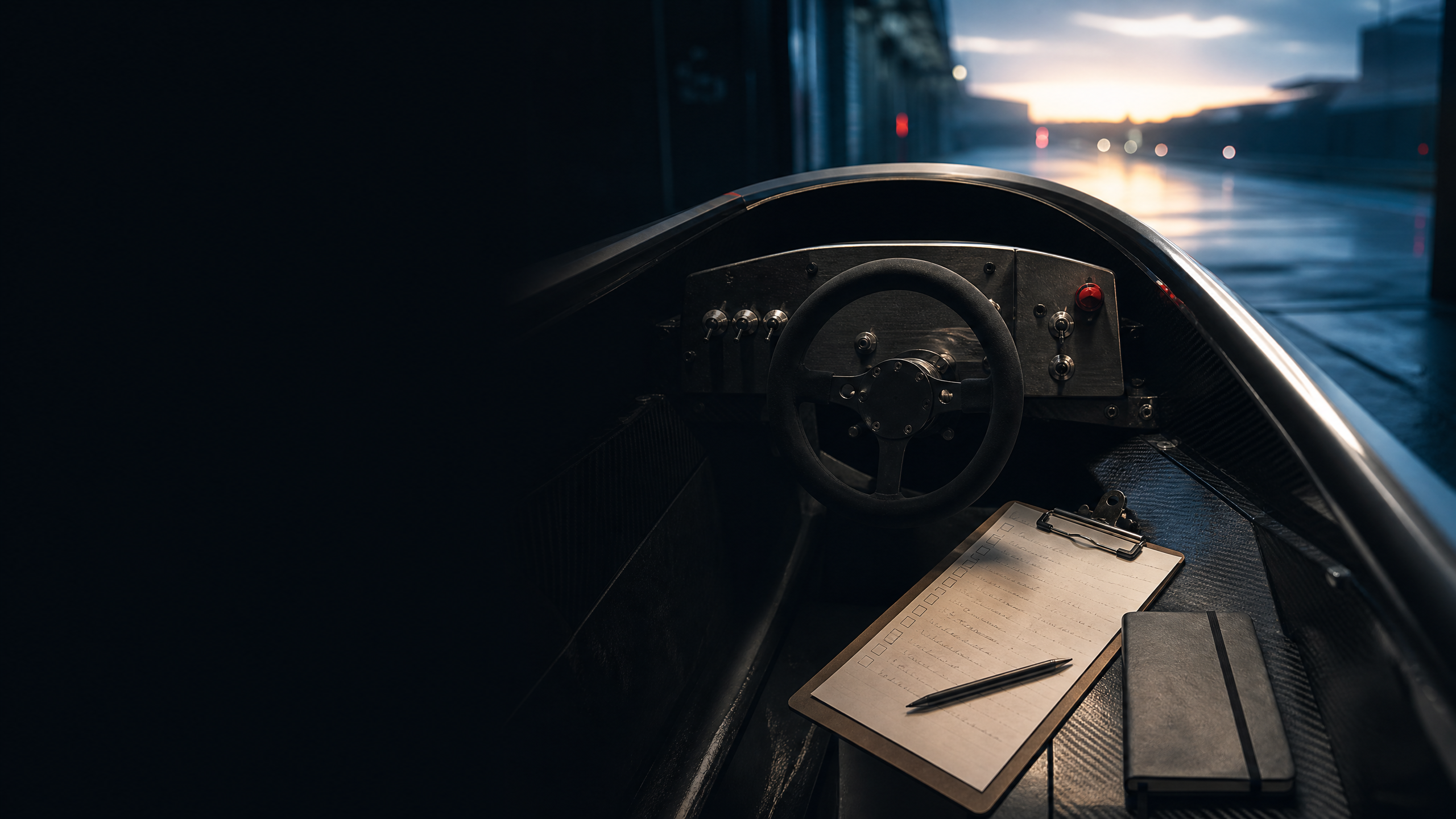
Public-safe editorial adaptation of the user-supplied FT-WEEKLY-2026-09-02 final-review package. It uses original editorial illustrations, not a Porsche vehicle, driver, competition, or real track, and does not represent a Fast Town racing program, affiliation, offering, outcome, or guarantee. View the current source.
Porsche’s new 911 Challenge shows why a credible customer-racing pathway is less about a specification sheet and more about helping drivers understand the transition into structured competition.
A credible move from track-day enthusiasm into customer racing is not about making the step easy. It is about making the next level understandable.
That is what makes Porsche’s newly announced 911 Challenge interesting beyond its specification sheet. The company positions it as an entry-level competition car for customer racing, built around familiar 911 GT3 technology and intended for one-make competition from the 2027 season. [1]
The gap is rarely only mechanical
A driver can know a road car well and still find organized competition to be a different world. The machine is one part of it. The rest is preparation: understanding the rules, working with a team, communicating clearly, managing data, building consistency, and learning how much can change when someone else is racing beside you.
“For customers who already enjoy tracking their GT3, the step into a dedicated Porsche race car becomes more natural and familiar.” — Volker Holzmeyer [1]
That does not mean familiar equals simple. It means the handoff between one level and the next has been designed with intention.
Road & Track independently noted that the 911 Challenge is meant to take the bottom rung of Porsche’s customer-racing ladder previously held by the 718 Cayman GT4 RS Clubsport. It also notes that the car is not street legal. [2]
Those two facts matter together. This is not a road car with a few accessories. It is a competition tool placed in a defined pathway.
A ladder gives ambition somewhere to go
In any performance culture, people need more than an invitation. They need a clear view of what the next commitment requires.
A credible ladder answers practical questions. What is the first serious standard? What does a participant need to learn before the next step? Where can they observe people who are already doing the work well? How does the environment reward preparation instead of only the loudest outcome?
That is why a structured customer-racing category can be compelling. It turns a vague aspiration into a sequence. Not everyone will take every step. But everyone can see the difference between watching the sport, participating at the edge of it, and committing to the discipline it demands.
The most useful performance communities work the same way. They give people access to information, settings, and peers that make a higher standard feel visible. They do not pretend that mastery arrives by proximity.

The details beyond the driver’s seat
It is easy to reduce motorsport to the moment a car leaves the pit lane. The important work starts much earlier.
There is the discipline of preparation: arriving with the right equipment, reviewing the schedule, checking the conditions, and understanding the rules. There is the discipline of communication: speaking clearly with technicians, coaches, and teammates when the information is incomplete and the clock is moving. Then there is the discipline of repeatability: being able to explain why a result happened and how to build on it.
Those are useful lessons outside the paddock as well. Ambitious people tend to be drawn to environments where performance is visible. The best ones also show the process behind it.
That is where Fast Town’s point of view is clear. Motorsport culture has real energy when it creates a setting for people who respect the work: the small decisions, the craft, the shared language of mechanical systems, and the relationships formed around a standard that has to be earned.

What to look for in a serious performance environment
Whether the interest is customer racing, a track day, or simply a better connection to the culture of motorsport, three questions are worth asking. Is the next step clear? Does the environment reward preparation? Are the people around the experience serious about the work?
Porsche’s new 911 Challenge will have its own place in the customer-racing landscape. The broader lesson is already useful: a good ladder lets people see what the next level requires without pretending the climb is anything but real.
Source note
This article comments on a reported Porsche product announcement and does not sell, review, recommend, or compare a vehicle. Fast Town has no stated relationship with Porsche, Porsche Motorsport, Road & Track, or the cited parties. The discussion excludes price, output, technical specifications, purchase guidance, availability, performance claims, and any assertion that Fast Town offers customer-racing access or a Porsche program.
References

Contributor
Phillip Mullennax
Journal contributor
Phillip Mullennax is listed as the author of this Fast Town Journal adaptation. His Leadership profile identifies his role in connecting editorial, media, analytics, and audience strategy across Fast Town’s public communications.
Continue the conversation
Related Articles
3 related articles

Motorsport Culture · Culture and Performance
When a Racing Technology Company Becomes a Team
By Phillip Mullennax
Moving from the pit lane to the grid changes the job. The work is no longer only the technology—it is the operating system that has to make it perform together.
October 4, 2026 · 4 min read

Motorsport Culture · Culture and Performance
When the Code Drives the Car
By Phillip Mullennax
Formula 1’s new energy-deployment systems make the relationship between driver, car, and software easier to see—and harder to reduce to a setup note.
September 28, 2026 · 3 min read

Motorsport Culture · Culture and Performance
The Test Track Is Becoming a Software Environment
By Phillip Mullennax
The test track is becoming more than a place to measure a machine. It is becoming a visible environment for software, systems, and people.
September 18, 2026 · 4 min read