
The Test Track Is Becoming a Software Environment
By Phillip Mullennax · · 4 min read

Fast Town Journal · Motorsport Culture · Culture and Performance
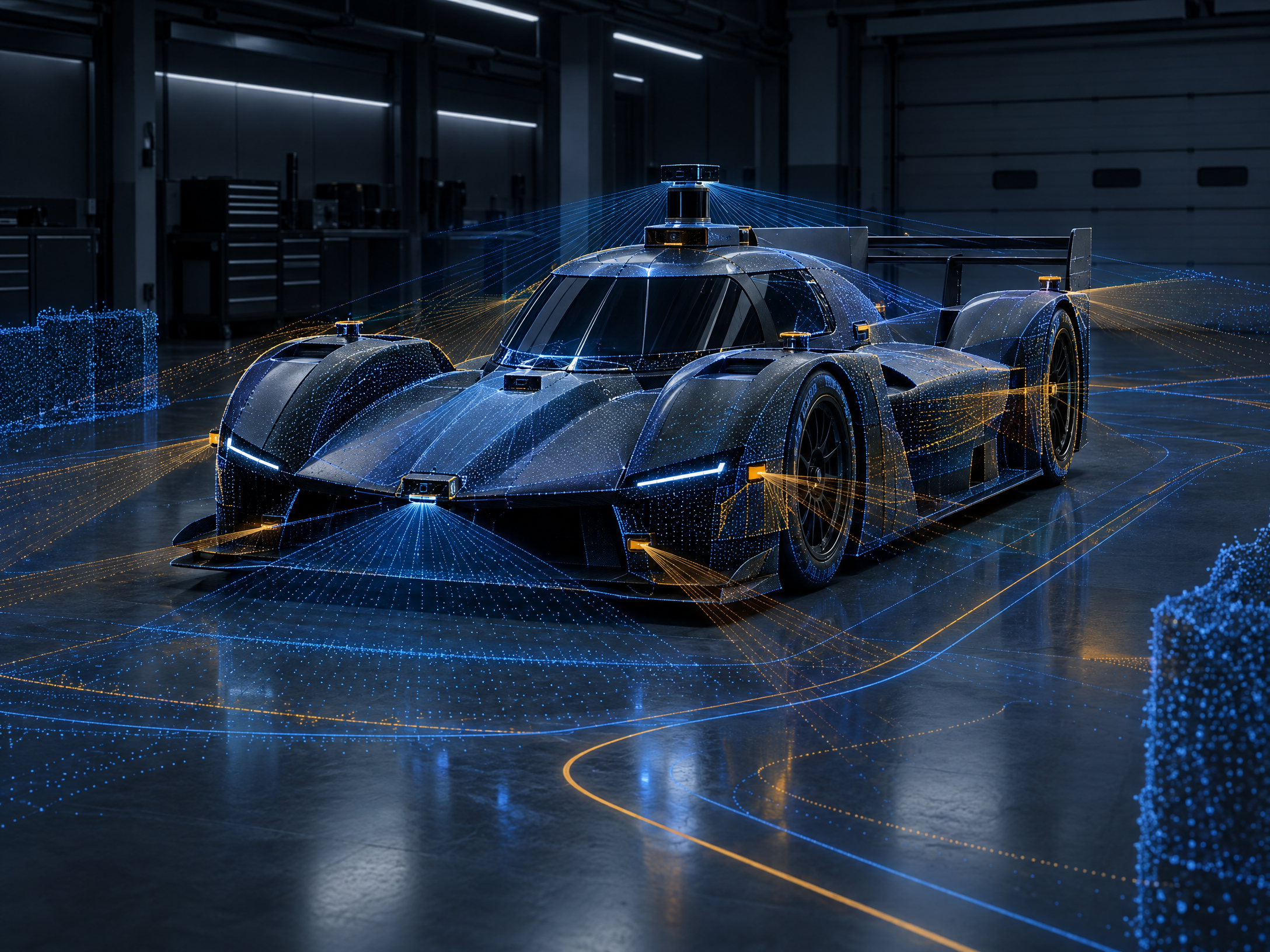
Original conceptual editorial illustration; not A2RL, Imola, team, or event imagery.
Public-safe editorial adaptation of the user-supplied approved Fast Town Weekly ICP final-release package. Original conceptual editorial illustration; not A2RL, Imola, team, or event imagery. View the current source.
The test track is becoming a visible environment where software, systems, and people have to meet a real standard.
A test track still rewards nerve, repetition, and mechanical understanding. It is also becoming a place where software, data, and systems thinking are exposed to the same public pressure as any other performance tool.
A2RL’s September 5 event at Imola is a narrow but useful example. Its official event page described the date as the league’s first international race, held as part of ACI Racing Weekend, and listed five participating teams: TUM, Kinetiz, Unimore, Constructor, and Polimove. [3] That does not settle the broader questions around autonomous technology. It does show why people are paying attention to these settings: a technical claim becomes more meaningful when it has to operate inside a visible environment with a clock, a track, and peers who are trying to solve the same problem.
The setting changes the standard
In a private demonstration, nearly everything can be controlled. The conditions can be selected. The audience can be managed. The story can be told in the order that favors the technology.
A real motorsport setting changes that. Even without making claims about results, safety, or technical superiority, the context itself adds useful pressure. Teams have to prepare. Systems have to be explained. Constraints are not hidden. They are part of the point.
That is what makes the test track interesting for anyone building a serious performance culture. The value is not in pretending that one event resolves an industry. The value is in putting an idea where people can see the discipline behind it.
Software needs a place to be tested
The phrase “software-defined” can become vague quickly. At its best, it describes a practical change: more of the performance decision-making is being shaped through data, computation, and iteration, even when the result still has to work in a physical setting.
That requires a new kind of fluency. The people in the room need to understand not just code or hardware, but how a system behaves when it is constrained by environment, time, and other people. They need places where discussion can move beyond abstraction.
A2RL’s Imola event points to that direction. It brought an autonomous-racing format to a historic circuit as part of an existing race weekend. [3] The significance is not that the circuit suddenly became a software company. It is that performance environments are becoming more useful to software builders—and software is becoming more visible to the people who care about performance.
Communities matter as much as machines
The next generation of motorsport entrepreneurship will need more than access to tools. It will need access to standards.
The most valuable performance communities are not built around a slogan. They give people a shared reference point: a problem worth testing, peers who can challenge the work, and enough proximity to see what preparation looks like in practice. That is how an ambitious concept becomes a better question, then a better system, then possibly a better result.
No one needs to predict the outcome of autonomous racing to see the opportunity in that model. The point is to create settings where technical curiosity is taken seriously enough to be tested.
The test track is becoming more than a place to measure a machine. It is becoming a visible environment where software, systems, and people have to meet a real standard.
Source note
This article relies on A2RL’s official Imola event page for the event date, first-international-race description, ACI Racing Weekend context, and listed participating teams. It makes no claim about race results, speed, safety, technology superiority, data security, investment, or Fast Town’s relationship with A2RL or any named team. [3]
References

Contributor
Phillip Mullennax
Journal contributor
Phillip Mullennax is listed as the author of this Fast Town Journal adaptation. His Leadership profile identifies his role in connecting editorial, media, analytics, and audience strategy across Fast Town’s public communications.
Learn more
Explore Fast Town’s public story around automobile culture, considered hospitality, place-led design, and the long view.
Continue the conversation
Related Articles
3 related articles
Motorsport Culture · Culture and Performance
When a Racing Technology Company Becomes a Team
By Phillip Mullennax
Moving from the pit lane to the grid changes the job. The work is no longer only the technology—it is the operating system that has to make it perform together.
October 4, 2026 · 4 min read

Motorsport Culture · Culture and Performance
When the Code Drives the Car
By Phillip Mullennax
Formula 1’s new energy-deployment systems make the relationship between driver, car, and software easier to see—and harder to reduce to a setup note.
September 28, 2026 · 3 min read
Motorsport Culture · Culture and Performance
The Next Step into Customer Racing Should Be Legible
By Phillip Mullennax
A new Porsche customer-racing entry point prompts a bigger question: what makes a meaningful transition from track-day familiarity to structured competition?
September 2, 2026 · 5 min read