
A Guided Look at Leadership: How Fast Town Organizes Its Public Point of View
By Phillip Mullennax · · 4 min read

Fast Town Journal · Leadership · Organization · Digital Experience
Public-safe editorial adaptation of the approved Fast Town Leadership and About walkthrough, published October 9, 2026. The lead video is a direct capture of public pages; no personal data was entered and no form was submitted. View the current source.
Leadership is most useful as a public directory: a way to understand current roles, the principles that frame the work, and the public route that fits the question.
Watch the walkthrough
See the public route in motion.
Public interface walkthrough · No personal data entered · No form submitted
Captions are available in the player. The walkthrough shows only the visible public site states described in this article.
The record, at a glance
The results behind the firsts
3
Directory groups
Executive Leadership, Global Operations, and Strategic Advisors
3
Public pages
Leadership, About, and Contact guide the route
0
Form submissions
The walkthrough enters no personal data
The Leadership page is designed as a public directory rather than a roll call. It organizes current public profiles into Executive Leadership, Global Operations, and Strategic Advisors, then connects that directory to the public principles on the About page and to purpose-specific contact routes. [1][2][3]
The walkthrough shows those visible states without entering any personal data or submitting a form. It is an orientation tool, not a statement about service, access, availability, transaction, or outcome. [1]
Start with the group
The current directory brings together public leadership, operating, and advisory perspectives. Executive Leadership frames direction and shared standards; Global Operations collects development, construction, safety, logistics, design, commercial, and digital perspectives; Strategic Advisors adds maritime, enterprise, and creative viewpoints. [1]
The useful first step is to choose the group that matches the context a visitor wants to understand, then open only the public profile that adds useful detail.
Use About for the connective tissue
About supplies the public frame around the directory. It presents stewardship alongside belonging, mastery, and momentum, while keeping clear boundaries around what public language can and cannot establish. [2]
Those principles are context, not a promise of access, service, availability, transaction, or outcome.
Choose the public route that fits
The Contact hub separates a public brief, membership interest, residence and marina interest, partnership inquiry, media and press, and general contact. These are routing tools intended to help the right human administrator receive useful context. [3]
Keep confidential, payment, identity, health, financial, accreditation, and offering information out of public forms. The walkthrough shows only public screens and does not submit a form.
Source note
This Journal companion uses the current public Fast Town Leadership, About, and Contact pages as its only sources. It makes no claim about individual endorsement, availability, service, access, transaction, partnership, membership, outcome, or private information handling beyond the visible public route language.
References

Contributor
Phillip Mullennax
Journal contributor
Phillip Mullennax is listed as the author of this Fast Town Journal adaptation. His Leadership profile identifies his role in connecting editorial, media, analytics, and audience strategy across Fast Town’s public communications.
Explore the public directory
See the current Leadership groups, then use the public route that fits your question.
Continue the conversation
Related Articles
3 related articles
Club News · Journal Discovery
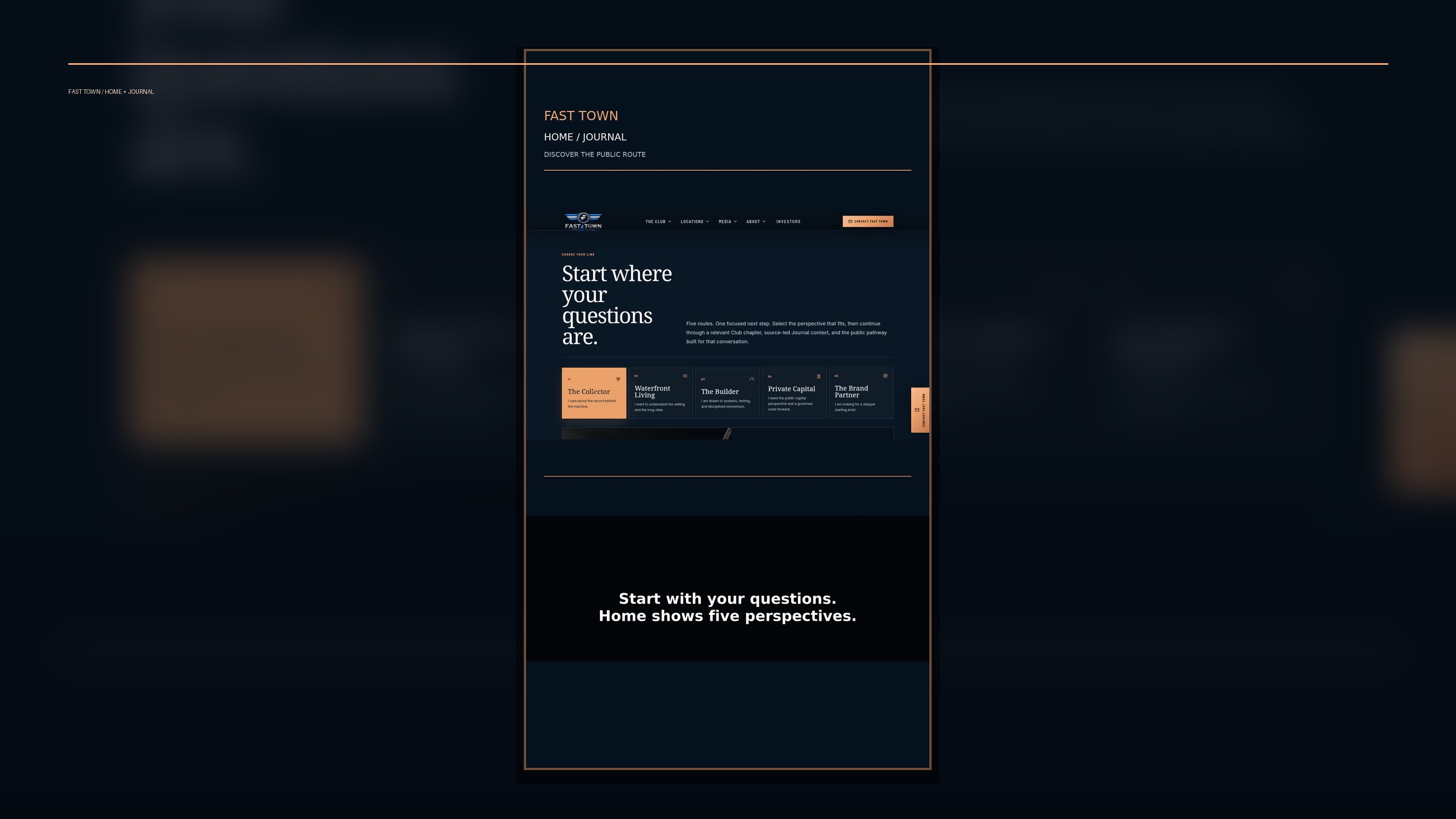
Start Where Your Questions Are: A Better Route Through the Fast Town Journal
By Phillip Mullennax
The Fast Town walkthrough is not asking readers to learn a new system. It is asking a simpler question: where do you want to begin?
October 7, 2026 · 4 min read

Development · Technology and Design
When Architecture Makes Its Environmental Work Visible
By Phillip Mullennax
A completed coastal project offers a design lesson: the systems that shape comfort should also belong to the experience of the place.
September 2, 2026 · 5 min read

Development · Technology and Design
All Throttle: Build the Building Around the Technology
By Phillip Mullennax
Why technology-first design starts with systems architecture, governance, security, commissioning, and evidence before physical decisions narrow the options.
September 1, 2026 · 7 min read