
All Throttle: Build the Building Around the Technology
By Phillip Mullennax · · 7 min read

Fast Town Journal · Development · Technology and Design
Public-safe editorial adaptation of the user-approved All Throttle CURRENT JOURNAL STAGING HANDOFF. The article retains its source-linked design and technology perspective without representing an engineering specification, vendor selection, partnership announcement, operational assurance, or future-performance statement. View the current source.
Building around technology means deciding how systems, data, power, networks, safety, operations, and experience must work together before the physical design makes those decisions harder to change.
A source-led editorial feature informed by Richard Madeira’s original LinkedIn article.
A technology-led destination begins with a different kind of decision
Building around technology means deciding how systems, data, power, networks, safety, operations, and experience must work together before the physical design makes those decisions harder to change.
A technology-led destination begins with a different kind of decision. Not: What software should we add later? But: What must the building make possible from day one?
That question is at the center of Richard Madeira’s LinkedIn essay, All Throttle | Build the Building Around the Technology. Madeira writes about the moment when a project has to choose whether technology will be forced to adapt to a finished plan or whether the plan will make room for the systems, people, and evidence that technology needs to do useful work.
The point is not to make technology the headline. The point is to make a complicated place feel considered when people actually use it.
RJ Hunt put the thought plainly in the essay:
“We want the technology now, and we want to build the building around it. Not adapt technology later.” — attributed to RJ Hunt by Richard Madeira [1]
That sounds obvious until you follow it all the way through.
The expensive decisions are usually the early ones
Most projects meet technology late. The building is planned. The mechanical systems are specified. The rooms are allocated. The walls are drawn. Then somebody asks how the controls, connectivity, security, access, energy, operations, and future digital services will work together.
By that point, technology is trying to catch up with a series of decisions it did not help make.
A technology-first approach asks different questions before that happens. Where does the data come from? Which systems need to exchange information? What should remain separate? Who owns the data? What happens if a network goes down? Where do control rooms, equipment, conduit, edge devices, and maintenance access belong? How will a team test the whole thing before it is asked to perform in a real operating environment?
These are not questions for a futuristic demo. They are questions for architects, engineers, operators, cybersecurity professionals, and the people expected to run a place day after day.
Siemens makes the point in direct language. Its work on IT/OT convergence describes the challenge as bringing physical building equipment and devices into the digital environment while maintaining cybersecurity. That is not simply a software exercise. It is the careful design of data flows, network boundaries, permissions, and operating responsibilities. Siemens specifically calls for planning around use cases and involving IT, cybersecurity, architects, consultants, engineers, and the construction team early. [2]
That is the distinction worth keeping in view. A building can have smart devices and still not have a coherent operating strategy. It can have dashboards without having clear data governance. It can have connected equipment without knowing which system is responsible when one part of the environment changes.
The building is physical. The decisions are not only physical.
When people hear “smart building,” they often think of a screen on the wall, an app in a phone, or a room that adjusts when someone walks into it. Those are the visible edges of a much larger operating question.
Operational technology, often shortened to OT, includes the systems that interact with the physical world: building automation, HVAC, lighting, fire safety, access control, physical security, power, meters, and other equipment that monitors or changes conditions. Information technology, or IT, includes the networks, computing, applications, data services, identities, and governance that allow people and systems to exchange information.
Bringing those two worlds together creates useful possibilities. It also creates responsibility.
The National Institute of Standards and Technology identifies building automation, physical access control, physical-environment monitoring, and other programmable systems as forms of operational technology. Its guidance is clear that OT security has to account for performance, reliability, and safety—not just conventional information-security concerns. [3]
That is why early integration work should not be confused with simply making more systems talk to one another. The goal is not maximum connection. The goal is intentional connection.
A useful architecture distinguishes between data that needs to move and data that does not. It defines who can make changes. It plans for safe failures. It makes room for maintenance. It avoids creating an environment where a convenient new feature quietly opens a problem somewhere else.
In a considered destination, those choices should be almost invisible to the person having dinner, arriving at an event, walking through a gallery, or meeting a friend. But invisible does not mean simple. It means the complexity has been dealt with in the right places.
What early technology work actually produces
The most consequential output of an early technology conversation is often not an app, a product, or a render. It is a list of decisions that gets made before those things become difficult to change.
That work is unglamorous. It is also where a technology story becomes credible.
At Siemens’ Wendell, North Carolina Electrification and Automation campus, the Customer Experience Center and Power Academy were created as part of a $36 million facility investment announced in 2024. Siemens describes the setting as a place where visitors can engage with power-distribution equipment and explore protection, control, and automation solutions. [4] Its 2026 microgrid announcement described the campus as a live example of connected energy infrastructure, combining generation, storage, building management, cloud analytics, charging, and training environments. [5]
That does not mean another project should copy the campus. It means a working environment can make the tradeoffs more concrete. Conversations become less abstract when you are standing in a facility that has to operate as a facility.
| Decision area | The question to resolve early | Why it affects the building |
|---|---|---|
| Experience | What should guests, staff, and operators be able to do without friction? | The answer shapes rooms, access points, service paths, interfaces, and operating procedures. |
| Systems | Which physical systems need data, control, or shared visibility? | The answer affects integration, equipment selection, controls, commissioning, and maintenance. |
| Network and security | Where can data move, who may use it, and how are systems protected? | The answer affects segmentation, identity, monitoring, resilience, and risk management. |
| Power and infrastructure | What equipment, loads, controls, and contingencies are required? | The answer affects electrical rooms, distribution, backup planning, space allocation, and coordination. |
| Operations | Who owns the alert, the decision, and the handoff when something changes? | The answer determines whether technology helps a team or merely adds another screen. |
| Evidence | What will be tested, measured, commissioned, and reported after opening? | The answer prevents a concept from being marketed as a result before it has been proven. |

Integration is a design discipline
There is a temptation to describe integration as if it were a single line on a technology plan: “connect the systems.” The real work is more specific.
An open building-management platform may help teams bring diverse systems into a shared operating view. Siemens describes Desigo CC as an open, multi-discipline platform for systems including HVAC, lighting, fire safety, security, and other building functions. It says the platform is designed for IT/OT convergence through northbound and southbound integration and can support third-party-system engineering. [6]
The important word is can.
A platform does not eliminate architecture. It does not settle governance. It does not make a complex environment secure by default. It does not guarantee that systems from different manufacturers will work together exactly as imagined. It gives a team a framework that still needs to be designed, integrated, tested, commissioned, monitored, and maintained.
The same is true of open standards. The BACnet Testing Laboratories listing for Siemens Desigo CC Workstation 9.0 shows certification across multiple profiles, including the BACnet Cross-Domain Advanced Operator Workstation profile, or B-XAWS. [7] That is meaningful technical context. It helps explain why a shared language and a tested interoperability profile matter. It is not a substitute for project-specific engineering.
The distinction may feel academic until a project changes. A new operator arrives. A supplier updates a controller. A security policy changes. A room changes its use. A system reaches end of life. A building that was designed around closed assumptions becomes expensive to adapt. A building designed around clear interfaces, authority, and evidence has a better chance of evolving without losing its bearings.
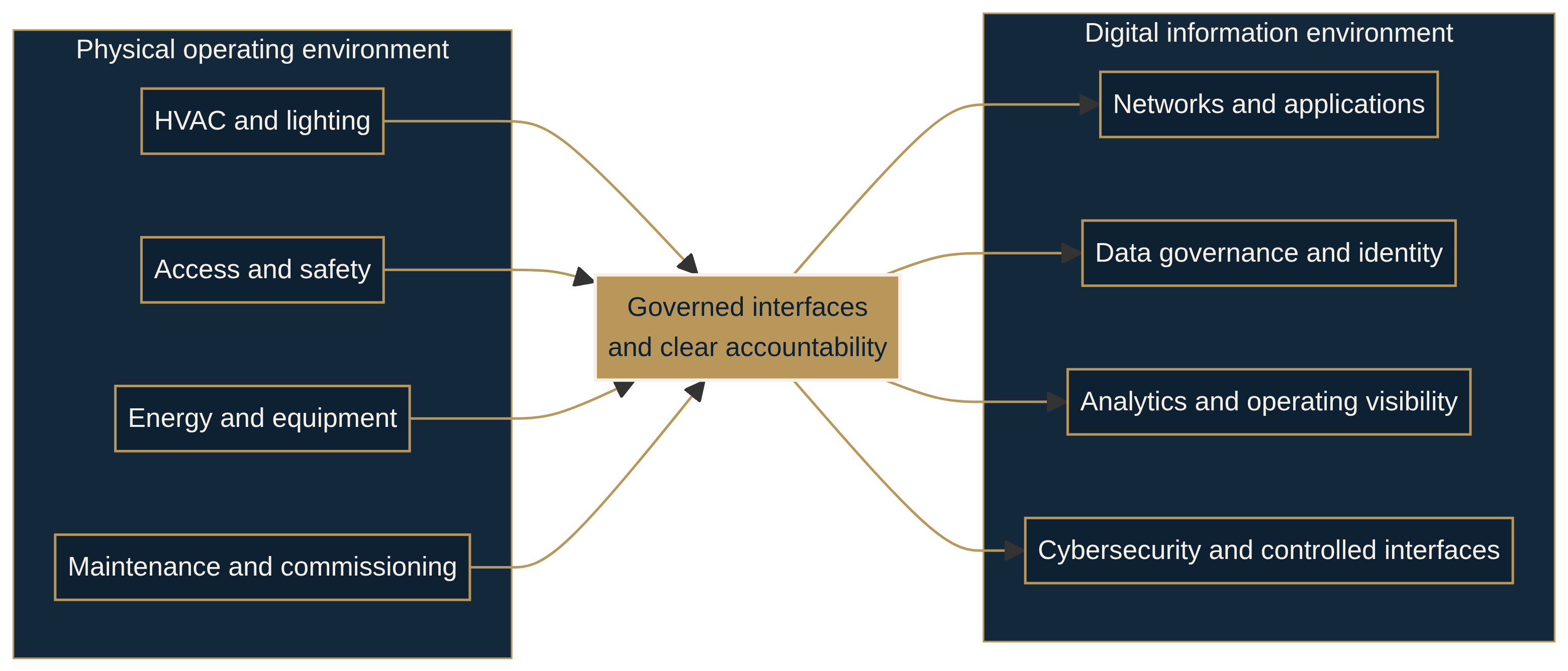
The right ambition is calm, not conspicuous
There is a difference between technology that is impressive during a tour and technology that is useful on an ordinary Tuesday.
The more complex the environment, the more important that difference becomes. The aim should not be to force every interaction through a device or announce intelligence at every turn. It should be to reduce avoidable friction while leaving people in control.
That is why the best technology stories are often stories about restraint. A well-planned system does not ask the guest to understand the building. It gives the operating team the information and control it needs to make the experience feel composed.
The same restraint applies to the way a development talks about technology before it opens. There is a good reason to be specific about methods and cautious about outcomes. A project can say it is doing the work early. It can say it is examining systems architecture before making late-stage constraints permanent. It can say that cybersecurity, operations, integration, and commissioning are part of the conversation.
What it should not do is turn an early design conversation into an operating promise.
Building X, for example, is described by Siemens as a platform built on secure, real-time data for building operations, with applications across energy and sustainability, safety and security, and operations and maintenance. Siemens says its platform includes open APIs and AI/ML capabilities for analytics and forecasting. [8] Those are useful reference points for the broader field. They do not confirm that a particular development has selected, installed, or operates the platform.
Keeping that line clear is not cautious copywriting. It is good practice.
The discipline is knowing what has not been proven yet
Madeira’s essay is valuable because it starts with a design question, not a finished operating model. The technology-first position is not a claim that every system has been chosen or every outcome has been guaranteed. It is a commitment to do the difficult coordination work before physical decisions harden around incomplete assumptions.
A credible technology path looks like this:
Intent → requirements → system architecture → design coordination → commissioning → operating evidence → public reporting
Every step matters. Skipping from intent to public certainty is how a technology narrative gets ahead of its evidence.
The building industry has no shortage of promises about artificial intelligence, digital twins, automation, and seamless experience. What is rarer is the willingness to start with the systems work: the interfaces, permissions, rooms, data boundaries, maintenance realities, test plans, and human accountability that make those terms useful.
That is the useful takeaway from “build the building around the technology.” It is not a reason to make grander claims. It is a reason to ask better questions sooner.

Read the source perspective
This article was informed by Richard Madeira’s original LinkedIn essay, All Throttle | Build the Building Around the Technology, which provides his firsthand framing of the technology-first design question.
The Fast Town Journal feature is an independent, public-facing editorial adaptation. It uses separately cited sources for general technology context and does not represent an engineering specification, vendor selection, partnership announcement, operational assurance, or future-performance statement.
Questions readers ask
What does it mean to build a building around technology?
It means deciding how systems, data, networks, security, operations, and experience must work together early enough that the physical design can support them. It is not simply adding technology after the building design is already fixed.
Why does IT/OT convergence need early planning?
IT and OT operate with different risks, lifecycles, and responsibilities. Early planning helps teams define the data flows, network boundaries, access rights, cybersecurity safeguards, and operational handoffs that a connected building needs. [2] [3]
Does an open building-management platform guarantee integration?
No. Open platforms and standards can support integration, but they do not replace project-specific engineering, cybersecurity review, commissioning, testing, and operational accountability.
What should a public technology story prove?
A public technology story should separate what is intended from what has been tested and measured. The most credible path is to describe the design method now and report operational outcomes only after evidence exists.
Source note
This draft presents a public design and technology perspective. It does not describe an offering, investment opportunity, transaction, membership availability, completed destination, vendor appointment, deployed building system, construction status, engineering specification, cybersecurity assurance, operating result, or performance guarantee.
References
- [1] Richard Madeira, “All Throttle | Build the Building Around the Technology,” LinkedIn, July 9, 2026
- [2] Siemens, “What is IT/OT Convergence in Smart Buildings?”, March 23, 2022
- [3] NIST, “Guide to Operational Technology (OT) Security,” SP 800-82 Rev. 3, September 2023
- [4] Siemens, “Siemens Invests $36M in Wendell, NC for Experience, Training & Sustainability,” September 26, 2024
- [5] Siemens, “Siemens unveils state-of-the-art microgrid at Wendell headquarters,” May 11, 2026
- [6] Siemens, “Desigo CC”
- [7] BACnet Testing Laboratories, “BTL Listing 31415: Siemens Desigo CC Workstation 9.0,” tested September 2025
- [8] Siemens, “Building X”

Contributor
Phillip Mullennax
Journal contributor
Phillip Mullennax is listed as the author of this Fast Town Journal adaptation. His Leadership profile identifies his role in connecting editorial, media, analytics, and audience strategy across Fast Town’s public communications.
Continue the conversation
Related Articles
3 related articles

Development · Technology and Design
When Architecture Makes Its Environmental Work Visible
By Phillip Mullennax
A completed coastal project offers a design lesson: the systems that shape comfort should also belong to the experience of the place.
September 2, 2026 · 5 min read

Development
Before the Render: Five Infrastructure Questions That Define a Waterfront Destination
By Phillip Mullennax
Five general planning questions about interfaces, information, operations, model validation, and critical infrastructure before a waterfront vision becomes a commitment.
August 13, 2026 · 5 min read
Development
Building Fast Town Daytona Around Technology From the Ground Up
By The Fast Town Team
Why a complex destination should make the hard integration decisions before construction rather than retrofit the operating experience later.
July 31, 2026 · 4 min read