
Start Where Your Questions Are: A Better Route Through the Fast Town Journal
By Phillip Mullennax · · 4 min read
Fast Town Journal · Club News · Journal Discovery
Public-safe editorial adaptation of the user-approved Fast Town Home / Journal walkthrough, published October 7, 2026. The lead video is a direct capture of Fast Town’s public pages; no personal data was entered and no form was submitted. View the current source.
A useful Journal gives a reader a clear first question, a sensible next read, and enough room to follow the thread at their own pace.
Watch the walkthrough
See the public route in motion.
Public interface walkthrough · No personal data entered · No form submitted
Captions are available in the player and are also burned into the video. The walkthrough shows only the visible public site states described in this article.
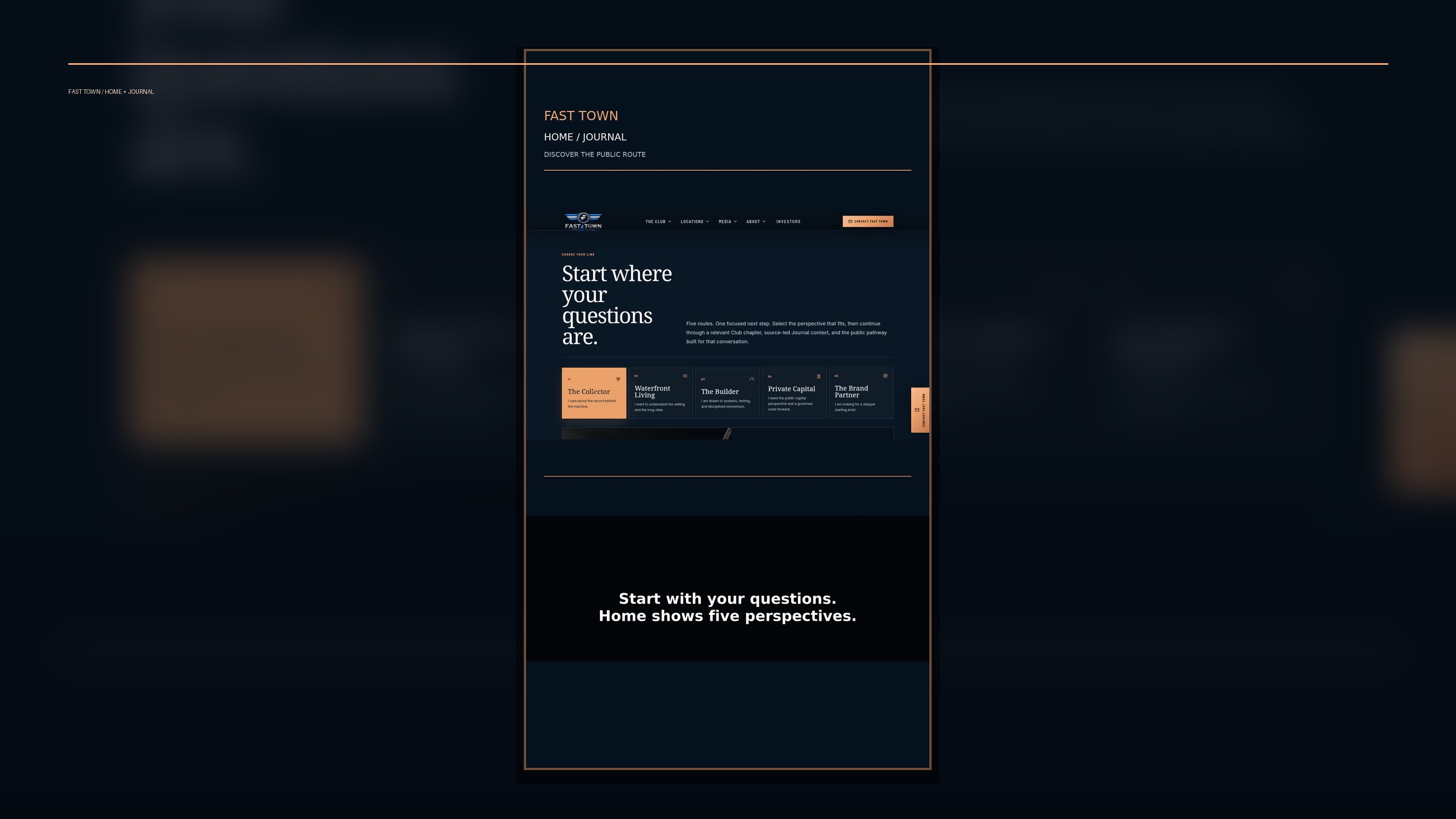
A useful Journal does not make the reader work out where to start. It gives them a clear first question, a sensible next read, and enough room to follow the thread at their own pace. That is the point of the 30-second Fast Town walkthrough: begin with the question in front of you, choose a perspective, and use the Journal as a route through source-led context rather than a pile of disconnected posts. [1]
The video opens with five perspectives on the Fast Town Home screen and the line, “Start where your questions are.” It is a simple piece of editorial direction. The goal is not to force every visitor through the same introduction. It is to offer a few credible places to begin, then make the next move understandable. [1]
A first screen should give a reader a way in
The Home view in the walkthrough presents five perspective cards beneath the prompt to choose a line. That is not a claim that every question has one clean answer. It is a practical way to avoid the opposite problem: a broad site that asks a new visitor to guess which door matters. [1]
A collector may want to begin with the record behind a car. Someone following a place may want more context before they spend time on a headline. A builder may be looking for systems, testing, or the work that happens before a result is visible. The point is not to turn those interests into fixed labels. It is to acknowledge that the first useful read is different depending on what brought someone here.
Good navigation is editorial work. It decides what comes first, what belongs together, and what a reader can reasonably expect from the next click. If the route is clear, the content has a better chance to do its own job.
The Journal is there to make the next read clearer
At 00:05–00:09, the walkthrough moves into the Journal and shows reading lenses, a search field, and categories. The on-screen language calls it “a better route through the Journal.” [1]
That phrase matters because a Journal should do more than publish. It should help a reader keep a line of inquiry intact. Search is useful when you know the term. Categories are useful when you know the territory. Reading lenses sit between the two: they help turn a general interest into a more specific next question.
That is the standard we are aiming for. A story about preservation should lead somewhere different than a story about motorsport culture. A reader exploring a waterfront context should not have to sort through unrelated material to find a useful starting point. The goal is not to make the Journal feel busy. It is to make it easier to stay with an idea long enough to learn something from it.
Save the story that earns a second look
The walkthrough then shows a Journal story page and a visible save action. The confirmation reads: “Article saved. Check Saved Articles on this device.” The video overlay says, “Save published stories locally. No account is required.” [1]
That is a modest feature with a practical purpose. Some pieces deserve more than a passing read. You may want to return to a source list, revisit a point after a conversation, or keep a story in view while you compare it with something else. The point is not to turn reading into a task list. It is to make a useful story easier to find again on the device you are using.
The walkthrough does not describe synchronization, recovery, storage duration, or use across devices. It does not need to. The visible promise is narrower: a reader can save a published story locally from the page in front of them.
Optional public updates should stay optional
The video also shows a Journal subscription form with a separate option to include public Florida location updates if they are published. The language is clear about the condition and the choice: these are optional public updates, not a location announcement or a claim about timing, access, or availability. [1]
That distinction is worth keeping. A useful Journal respects the reader’s reason for subscribing. Some people want the writing and nothing else. Others may want to hear about public updates when there is something appropriate to share. The preference belongs with the reader, and the wording should remain as direct as the video makes it.
Explore at your own pace
The final instruction in the walkthrough is the right one: “Choose the line that fits your questions. Explore at your own pace.” [1]
That is how the Fast Town Journal should feel. It is not a demand for attention or a shortcut to an answer. It is a place to follow a subject with more care—whether the starting point is a vehicle record, a race, a technical idea, a cultural story, or a question about place.
Start where the question is. Save what earns a second look. Come back when the next question arrives.
Source note
This article uses Fast Town’s published 30-second Home / Journal walkthrough as the sole evidence for the visible interface states described. It makes no claim about backend processing, data security, account persistence, synchronization, cross-device use, storage duration, location timing, access, priority, availability, commercial offerings, or investor matters. The optional Florida location-updates preference is presented only as a conditional public preference if updates are published.
References

Contributor
Phillip Mullennax
Journal contributor
Phillip Mullennax is listed as the author of this Fast Town Journal adaptation. His Leadership profile identifies his role in connecting editorial, media, analytics, and audience strategy across Fast Town’s public communications.
Learn more
Explore Fast Town’s public story around automobile culture, considered hospitality, place-led design, and the long view.
Continue the conversation
Related Articles
3 related articles

Development · Technology and Design
When Architecture Makes Its Environmental Work Visible
By Phillip Mullennax
A completed coastal project offers a design lesson: the systems that shape comfort should also belong to the experience of the place.
September 2, 2026 · 5 min read

Development · Technology and Design
All Throttle: Build the Building Around the Technology
By Phillip Mullennax
Why technology-first design starts with systems architecture, governance, security, commissioning, and evidence before physical decisions narrow the options.
September 1, 2026 · 7 min read

Development
Before the Render: Five Infrastructure Questions That Define a Waterfront Destination
By Phillip Mullennax
Five general planning questions about interfaces, information, operations, model validation, and critical infrastructure before a waterfront vision becomes a commitment.
August 13, 2026 · 5 min read